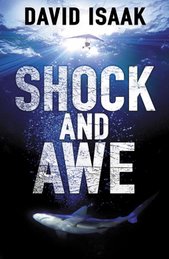
Now here's a curiosity for you, though I discovered it too late to fully enjoy it: a site called BookkooB. It compares prices for a book between different online retailers (yawn), but for lovers of trivia, coincidence, or synchronicity (pick one depending on your philosophic orientation) it also tells you what books are being published on a particular date.
Unfortunately, it isn't archival, and the entries appear to be writ in water. As far as I can tell, tomorrow we will no longer be able to access information about September 7th, 2007. So I hasten to inform you that 66 books were published in the UK on the 7th. In addition to the most important book--Shock and Awe, that is--this was also the pub date for:
The Pan paperback version of North by Brian Martin (congrats, Brian--I always liked that book)
The Late Hector Kipling by David Thewlis (yes, that David Thewlis)
The Gruffalo's Child by Julia Donaldson (yes, that Gruffalo)
The Boss's Wife for a Week by Anne McAllister (you guessed it, Harlequin Mills & Boon)
The Oxford Handbook of Systematic Theology (no author listed--maybe God wrote it?)
You can look forward easily enough by using the little calendars on the sidebar, so you can see who shares pub dates with LC Tyler (The Herring Seller's Apprentice), Faye L. Booth (Cover the Mirrors), or Peter Anthony (A Town Called Immaculate). Three months seems to be the limit, though; I don't find Alis Hawkins (January) or Aliya Whitely (February--is she prolific, or what?) in the opening months of 2008. Yet.
Meanwhile, a friend has received the following e-mail from Amazon UK:
Dear Customer,
We wanted to give you an update on the status of your order. We are sorry to report that the following items have been delayed:
David Isaak (Author) "Shock and Awe" [Hardcover]
Estimated arrival date: 15/10/07 - 31/10/07
We are sorry for any inconvenience this causes.
If I recall, something like this happened to Eliza Graham back in June. One can only hope that the astonishingly heavy orders caught them off guard. Yeah...that must be it.
And apparently the short supply is bidding up the price--although the Amazon UK website insists the book is "in stock", the price has jumped from £9.89 to £10.49. I guess I'd better hang on to my copies. Guess there's a run on the market.
Friday, September 7, 2007


Hey, Look--It Seems to be September 7th...
There is something mythic about the date of publication, and you actually come to believe that on this one particular morning you will wake up to the phone ringing off the hook and your publisher will be so excited that they will have hired the Blue Angels precision flying team to buzz your squalid little hovel, which you will be moving out of as soon as sales of the book really take off.
Anne Lamott,
Bird by Bird
With Ms. Lamott, as well as a number of published acquaintances, to disabuse me of wild notions, I didn't have overamped expectations for today. So far, though, it's been a pleasant time. Had a nice note from editor Will Atkins, some e-mails from friends and relatives, and, best of all, the first sighting ("in the wild" as he put it) of Shock and Awe.
Eagle-eyed Tim Stretton spotted it--two copies--in a Waterstones in Chichester. (He says there may have been a third, as there was a gap between me and John Irving.)
I've never been to Chichester. My travels to the UK have encompassed London and Oxford and London and Salisbury and London and London and London and London--sort of like the Monty Python Spam menu. But I'm now convinced that Chichester is a vastly civilized place, with cultivated tastes. (Plus, glancing through Wikipedia, I see that one of the Chichester city fathers was the first man to be killed by being hit by a locomotive. Now there's glory for you.)
If any of you spot my book on the shelves in the bookstores you haunt, let me know. Of necessity I'm living vicariously here.
Ooops, gotta run! I think the Blue Angels are flying over...
Tim Stretton Joins the Blogosphere...
Tim Stretton, whose The Dog of the North is forthcoming from MNW next July, has thrown aside his skepticism and good common sense about how to spend his time and launched his own blog, named (like his website) ::Acquired Taste. It's his first day amongst the chattering classes and he's already posted three times, so you ought to go take a look before you have to run to catch up.
(And, no, I don't know what's up with the "::" symbol. But I'd advise against staring at it for too long. You never know.)
(And, no, I don't know what's up with the "::" symbol. But I'd advise against staring at it for too long. You never know.)
Thursday, September 6, 2007
A Simple Question or Two
Okay, I’m familiar, from watching friends’ books get published, with the fact you can often buy “used” copies on Amazon even before the book is formally available. I assume these are usually review copies the reviewers have dumped on the market.
I haven’t tried working out the economics of this. Do reviewers make the majority of their income from selling their review copies? Perhaps someone can enlighten me on this. (Perhaps my pal David Thayer, who receives review copies by the cartload.)
In any case, I’m not puzzled that Shock and Awe, which is now available on Amazon (subtle hint), should be accompanied by a bunch of offers to buy copies from other sources, in mint conditions, at lower prices. But why would anyone be offering to sell on Amazon for above Amazon’s price? Amazon is selling the book for £9.89. Two people want to sell it for about £8.90—so far so good. But the rest of the offers are all around £11.99. What’s the point of that? Are there people who go onto Amazon but refuse to buy books from Amazon but still buy books through Amazon? Is there a special Executive Edition of the book out there that plays a tune when you open it?
A little over a week ago, Faye Booth updated the ever-expanding list of online retailers handling her forthcoming Cover the Mirrors (subtle hint). She raised an eyebrow at the fact the book was being handled by Computer Manuals.
Being a nosey parker (which I discovered from reading Edward Charles’ In the Shadow of Lady Jane, actually means being a nosey gamekeeper—who knew?), I checked to see if Computer Manuals was also handling Shock and Awe, or if they’d somehow decided that Cover the Mirrors was a new programming language.
Indeed, when I searched on Isaak, I found that they were selling my book (three cheers for them!). There it was, listed right between Russian Space Suits: Soviet/Russian Space-Suit History by Isaak Abramov and A. Ingemar Skoog, and The Compleat Angler by Isaak Walton. Shock and Awe: £10.94. Computer Manuals seems to sell a complete range of fiction, including self-published novels from the United States.
But someone called Computer Manuals is listed twice on Amazon as wanting to sell copies for £11.99…
Is this a shell game? A tax dodge? A system by which terrorist communicate commands to their distant cells?
The book business is really odd.
Wednesday, September 5, 2007
Dialogue Tags and Mechanics, V
I asserted (or maybe "said") before that dialogue tags are a convention for accomplishing one thing, namely pointing to the speaker. But the tags themselves, no matter how invisible to the reading eye, have a rhythm in the reader's ear. Rhythm in dialogue is not only a rhythm of beats, but, for lack of a better term, a rhythm of meaning. This is an element of prosody that comes naturally to many writers, but only with experience to others.
There are important rhythmical differences between
"I want them and I intend to have them," Lizzie said.
and
Lizzie said, "I want them and I intend to have them."
and
"I want them," Lizzie said, "and I intend to have them."
Because prose, like music, is a linear modality, whatever comes last gets a slight, undeserved (and sometimes unwanted) emphasis. In the first example, we get the dialogue, followed by the tag, which throws the emphasis very slightly to Lizzie rather than to what she said. In the second example, we reverse this, giving the reader Lizzie first and then throwing the emphasis onto what she said, which tends to sound a bit more dramatic.
The third example, of course, is the most dramatic of the three, because it temporarily suspends the dialogue (indeed, suspends meaning), like an actor pausing for a beat in delivery. The suspense throws the emphasis heavily to the last part of the line. The first example imparts a more matter-of-fact tone; the third sounds as though Lizzie is really making a point.
The beat can be added even more effectively (and sometimes overdramatically) by what actors call "business":
"I want them." Lizzie turned away and crossed her arms. "And I intend to have them."
It is also legitimate to insert business through em-dashes, which break the dialogue without inserting a true tag, but let the sentence run without a period:
"I want them—" Lizzie turned away and crossed her arms—"and I intend to have them."
The convention on how this is punctuated is still under debate; you also see
"I want them"—Lizzie turned away and crossed her arms "—and I intend to have them."
and several other combinations. I happen to like the em-dash interruption, but it has had a pernicious effect on how dialogue is written, leading some writers to believe they can write
"I want them," Lizzie turned away and crossed her arms, "and I intend to have them."
That's a comma splice, as is
"I want them," Lizzie smiled, "and I intend to have them."
which, to compound the sin, has her "smiling" her words.
Some writers don't seem to realize that a full stop in the middle of dialogue is legitimate. So instead of
"I want them." Lizzie turned away and crossed her arms. "And I intend to have them. And if anyone wants to fight about it, they can see me in court." She glanced back over her shoulder with a feral glaze to her eyes. "Or, perhaps they'd like to meet me in single combat?"
we get
"I want them," Lizzie turned away and crossed her arms, "and I intend to have them. And if anyone wants to fight about it, they can see me in court," she glanced back over her shoulder with a feral glaze to her eyes, "or, perhaps they'd like to meet me in single combat?"
I have no intention of meeting Lizzie in in combat, since she's beginning to seem a bit daffy (and I have no clue what it is she wants, though she's pretty damned insistent), but the second version of the paragraph is a run-on trainwreck. It's fine to put business into dialogue with full stops. Not everything needs to be stitched together with commas. Honest.
Dialogue Tags and Dialogue Mechanics VI (What, Still?)
DICK AND JANE
Since I’m on a prolonged rant, let me make a brief mention of ordering within the dialogue tag. Technically, both
“Hello,” she said.
and
“Hello,” said she.
are both correct. And I’ve seen some writers in workshops who switch them around at random moments, said-she following she-said, apparently for the sake of variety.
I find said she jarring. At times, it strikes me as stilted and a bit archaic, with a Quoth-the-Raven flavor. At other moments, it reminds me of a bad children’s book:
“Look, Jane!” said Dick. “See Spot run!”
“Run, Spot, run!” said Jane.
When in doubt, try moving the tag to the front of the sentence. If it sounds odd there, then it’s probably sounding odd to some of us elsewhere:
Said she, “Hello.”
See what I mean?
ADVERBS WITH BADVERBS
If you’ve read my previous remarks on dialogue tags, you probably won’t be surprised to hear that I don’t care for adverbs in tags. Unusual attribution verbs draw my attention; loading on an adverb compounds the problem. It makes me terribly conscious of the fact that there’s an author lurking on the page.
Now, odd attribution verbs and adverbs modifying them don’t always knock me out of the story. If the author is talented enough, I may gloss right across them. But since I see them as a potential sticky spot in the prose, I avoid them.
If I were unable to live without them, though, I’d worry about where I put them. For instance
“You haven’t seen what’s in the letter yet,” he hinted ominously.
By the time I finish that line, I’m thinking about ominous hinting. I’ve pretty much forgotten about the letter. This is especially a problem if the dialogue is good (unlike my example), as the dialogue tag shouts too loudly. At the minimum, if I’d die without ominous hints, I’d at least rearrange it to end on the dialogue (see remarks under DICK AND JANE):
He hinted ominously, “You haven’t seen what’s in the letter yet.”
This way we at least get the attribution out of the way so we can pay attention to the dialogue. When I suggest this to writers who are addicted to “creative” dialogue tags, they tend to say, but He hinted ominously looks weird at the beginning of the sentence. True enough. If you pay attention, it looks pretty darn weird anywhere in the sentence, while there’s no problem with
He said, “You haven’t seen what’s in the letter yet.”
Of course, if you don’t think the ominous line gets enough ominosity (excuse me—I meant ominosituousness) from the words themselves, you can always add business:
He held his breath for a moment before he said, “You haven’t seen what’s in the letter yet.”
In addition to being distracting, most of the –ly adverbs that pop up in tags are abstract and judgmental. Excitedly, nervously, ominously, heatedly, and their allies all lean more toward telling and less toward showing. Most of us have learned to dramatize important moments rather than explaining them—having a man leave the room by slamming the door, rather than having him leave “angrily”; but some writers are still comfortable with having those –ly adverbs in their dialogue tags, as though the tags are a nature preserve for endangered abstractions.
These sorts of things can be overlooked or ignored by readers, but they certainly don’t make for stronger writing.
Or so said I.
Sunday, September 2, 2007
Dialogue Tags and Mechanics, IV
TELLING: FEAR AND ECONOMY LINK ARMS
Verbs of intonation—though they often become preposterous—at least try to serve the same purpose as ‘said,’ even as they fluster and giggle themselves into cuckooland. There exists, however, another entire category of said substitutes that, rather than trying to show intonation, explain or expand on the dialogue. Most writers are familiar with the old saw, “Show, don’t tell;” dialogue tags of this type are designed to tell what presumably ought to have been shown only a few words previously.
It can be difficult to distinguish writers who fear their dialogue doesn’t convey enough from those who think their readers are rather dense; some may believe both at once. In any case, this kind of dialogue can be hilarious in its redundancy:
“You bet I will!” he affirmed.
“Do you think that’s possible?” he wondered.
“I disagree with this!” he objected.
And, of course, the champion of them all, from Robert Ludlum’s The Bourne Ultimatum:
“I repeat,” repeated Alex.
Redundancy is usually just clumsiness. But sometimes writers have other goals. The dialog may not be definitive enough to carry the message—or so they worry—and therefore they prop it up with ‘taunted,’ ‘teased,’ or ‘joked.’ (Or ‘threatened,’ ‘hinted,’ or ‘insinuated.’) And, true, sometimes the reading of even a good line may not be found in the line. “Don’t make me kill you,” could be a genuine threat or a mild joke. But if we need to be told that it is a joke, there must be something severely lacking in the characterization, the atmosphere of the scene, and the context of the surrounding sentences.
The intrusion of the author with a verb in the dialogue tag at such a point is as arbitrary as a laugh-track, and because it interferes directly with the mechanics of dialogue conventions, it is clear that it is the writer telling us what to think.
Some writers defend their “mused,” or “expounded,” or “lectured” on grounds of economy. Indeed, it is more economical than giving full context. It is also more economical to say, ‘John was mad,’ than to dramatize John’s anger and let the reader work it out. More economical is not always more effective.
The purpose of a dialogue tag is to tell the reader which character said the words within the quotation marks. It is not the place for characterization, or describing action, or conveying mental states. The tag is a very simple mechanism, and loading more freight onto such a slender bar can deform it.
AND, FINALLY, THE JUST-PLAIN BAFFLING
Said substitutes can endeavor to be funny, or to describe tone of voice, or to tell us something about motivation. Most of the time, such efforts are suspect, and more likely to detract from the story than add, but at least they have a purpose. But some ‘said’ substitutes seem to have no reason to exist other than a writer’s desire for variety. What possible good is “he replied,” or “he answered”? In what context and with what dialogue would this not be obvious?
Even odder are constructions such as “he stated,” “he uttered,” or “he articulated.” (As a number of friends have pointed out, JK Rowling is fond of "he ejaculated." Talk about distracting...) These words may seem to add weight to the wispy verb ‘said,’ but weight isn’t what is wanted. If the message that the reader takes away from your carefully crafted dialogue is not the power and sense of the dialogue itself, but rather the fact that it was ‘intoned,’ then you have cut the feet from beneath your story.
There are greater sins in dialogue tags than ‘said’ substitutes: adverbs that clamor for attention, overlong ‘as’ clauses that try to hitch a ride, and trailing actions that run on so long that the dialogue is forgotten by the end of the sentence. But these bad habits all begin, I believe, when the writer first attempts to be creative with the attribution verb itself. Instead of being a simple pointer to the speaker, the dialogue tag becomes a handy crate, which can be loaded with whatever junk the author finds it convenient to stuff inside.
“A dialogue tag shouldn’t carry much freight,” she cautioned ominously yet imperturbably as she sat at her keyboard, turning occasionally to glance out the window to see if the crows, which had been nesting in the twisted Ponderosa Pine just visible through the dusty glass, had returned with more roadkill to feed to their ravenous, cawing young.
“I see what you mean,” he said.
Oh, and adverbs...well, that's another post or two.
Subscribe to:
Posts (Atom)