By the time a literary concept becomes entrenched in Hollywood, you know there's something wrong with it. I admire Joseph Campbell; I've even read his books. Hey, even books apart from the ubiquitous Hero With a Thousand Faces. Of course, most people in Tinseltown haven't read even Hero (which doesn't prevent them from talking about it). Instead, the more literate ones have read Chris Vogler's The Writer's Journey, while the less literate have taken a weekend workshop in The Hero's Journey from some screenwriter.
But, much as I admire Campbell, if I hear about the "template" of The Hero's Journey one more time, the person speaking is going to find themself joining Eurydice in the most inaccessible corner of Hades, never to return to the world of the living.
But, enough of that particular rant. What is ammoying me at the moment is that the related buzzwords, "character arc", have now become permanently lodged inside Hollywood's thickish skull. It's not a bad concept, character arc, though it's a little vague. But I'm getting pretty damned tired of being told that the important characters in every successful story have one. And, this being Southern California, what writers talk about gets pikced up by Hollywood, and then in turn is recycled out of Hollywood and back into the coffeeshops by the more paint-by-numbers sort of writers. You can't mention anything about a character without someone asking, "Okay--but what's his arc?" Because current gospel is if said character doesn't have an arc, we don't have a story. Well, horse patootie.
My counterexample: James Brooks' Broadcast News. The people at the beginning of the story are exactly the same people at the end of the story. Sure, they're bigger and older and a little sadder, but if that's a 'character arc' then the term is pretty useless. (If you haven't seen Broadcast News, watch it. Brilliantly structured, and pulled off so entertainingly that you don't notice the big pillars of the structure.)
Brooks isn't subtle about his non-arcs, either. There are three protagonists, and they are introduced as children in three short prologues, each of which end with a subtitle announcing who they are destined to become, such as "Future Network News Anchor."
Holly Hunter's character is in many ways the compass of the piece, because she is afflicted with a devastating clarity that lets her see what is happening...and forever destines her to be unhappy. (One character says to her, "It must be nice to always be right." With her voice cracking, she manages to reply, "No...no, it's terrible!")
One of her traits is that she micromanages, and there is qhat appears to be a recurring throwaway character joke: she is constantly instructing taxi drivers, in excruciating detail, of how best to navigate to their destination. ("Don't go by the park, because this time of fay there's always a lot of people try to...")
After the climax of the film, when she is utterly defeated and beaten, she climbs into the back seat of a cab and says, "Don't take the Beltway, because at this time of day there's gonna be a lot..." She pauses, and then says, "Oh, go any way you want."
This looks like an arc of sorts, doesn't it?--a little epiphany, a shift in her character. But as she slumps back in the seat, fighting tears, she gathers herself and mutters under her breath, "But New York Avenue's faster."
The real message of Broadcast News isn't about how people change. It's about the fact that people really don't, and someday need to accept who they are. Character is shown to be surprisingly inflexible, and character is shown to be destiny. The movie plays as a comedy, but it's really more of a Greek drama.
I admit, you can make a great story out of how a character is changed by events. But you can also make a great story out of how someone refuses to be changed by events--or even how someone refusing to change can drive events (ala A Man for All Seasons).
Remember, if Hollywood executives are chanting it, it can't possibly be wisdom.
Sunday, September 21, 2008


Thursday, September 18, 2008
A Macmillanite Visits California
 Many of the London crowd will recognize Jonathan Drapes, author of the hilarious MNW novel Never Admit to Beige. Fewer will recognize the sands of Hermosa Beach behind him. ( Okay, I admit the sand isn't terribly distinctive. It takes an expert to distinguish the sand of Redondo Beach from the sand of Hermosa Beach, and I doubt that most readers here are trained Sandinistas...or whatever it is they call sand experts.)
With Jonathan is his better half Katherine, and, in the startling plaid hat, their daughter Jessica, who at this point had about enough of fooling around and being cute for visitors and wanted to head off for bed.
Though Jonathan had been a denizen of London for some time, he's on his way home to Brisbane; England's loss, but Australia's gain. Luckily, they decided to stop over just up the road from us (well, by California standards). So Pamela and I had a chance to have a chat and dinner with them, and JD and I had a chance to whine a bit about the whole process of writing.
While Macmillan New Writing may be a very British imprint, if you sum it up they've now published quite a few of us seditious aliens. At this point, I guess that--lessee, one, two, three, four...I make it no less than seven of us are from the outside. (That would be five Americans--Michael Stephen Fuchs, Peter Anthony, Ann Weisgarber, Doug Worgul, and, of course, Yours Truly--as well as the delgates from India [Suroopa Mukherjee], Ireland [Brian McGilloway], and, of course, Jonathan, who hails from the outskirts of Oz.) Jonathan, who works in advertising, was savvy enough to relocate to London just before his novel was published. (And now that it's out and the novelty effect has worn thin, he's savvy enough to disappear. This is somebody who understands PR.)
Alas, those of you who live in the UK and didn't meet Jonathan and Katherine seem to have missed your chance. Though I suppose he might move back next time he publishes a book. In the meantime, you can always pick up a copy of Never Admit to Beige, which I guarantee will be one of the funniest books you've read. Almost every review on the Amazon UK page for the book uses the phrase "laugh out loud." They mean that in a very literal sense; don't read this in public, or you'll finding everyone edging away from you.
And, best luck to Jonathan, Katherine, and Jessica back on the Gold Coast.
Tuesday, September 16, 2008
Three of Me for Two
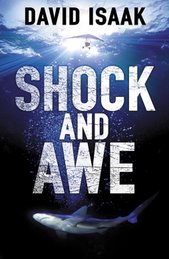
The intrepid Matt Curran has pointed out that the paperback of Shock and Awe is on the 3-for-2 table in Waterstones, which is an instance of what the Japanese call 'the ascent to heaven.'
[nb. Actually, 'the ascent to heaven' is when someone working in a Japanese corporation takes a job in the government body that regulates the corporation. But I love the phrase and had to sneak it in somehow.]
So, those of you near a Waterstones could dance on down and pick up three copies, keep one, and give two of them to friends. (Or, if you decide you hate the book, you could instead give all three to people you dislike.)
To be fair, though, Matt says that Faye Booth's Cover the Mirrors and Annabel Dore's The Great North Road are both there as well, and you might want to buy those two instead of the two extra copies of mine. (Sigh.) If you want to maximze your Forest Products Consumed Per Unit Cash--and pick up a truly unusual novel--you will definitely want to buy The Great North Road. Faye's Cover the Mirrors is a marvelous read, but weighs in at a sensible 318 pages; and Shock and Awe, at 472 pages, contains a few more words than any reasonable person could want; but, at 679 pages, The Great North Road can stop any bullet that doesn't have a full metal jacket.
I recommend buying all three.
[nb. Actually, 'the ascent to heaven' is when someone working in a Japanese corporation takes a job in the government body that regulates the corporation. But I love the phrase and had to sneak it in somehow.]
So, those of you near a Waterstones could dance on down and pick up three copies, keep one, and give two of them to friends. (Or, if you decide you hate the book, you could instead give all three to people you dislike.)
To be fair, though, Matt says that Faye Booth's Cover the Mirrors and Annabel Dore's The Great North Road are both there as well, and you might want to buy those two instead of the two extra copies of mine. (Sigh.) If you want to maximze your Forest Products Consumed Per Unit Cash--and pick up a truly unusual novel--you will definitely want to buy The Great North Road. Faye's Cover the Mirrors is a marvelous read, but weighs in at a sensible 318 pages; and Shock and Awe, at 472 pages, contains a few more words than any reasonable person could want; but, at 679 pages, The Great North Road can stop any bullet that doesn't have a full metal jacket.
I recommend buying all three.
Monday, September 15, 2008
The Fruits of Surgery
Leslie Schwartz, a fine novelist I know, once advised a class of writing students, "Be fearless about cutting, even if the sections you cut are some of your best writing. You can always set them aside in files of their own and use them for another project some day."
Then, with a sly smile, she added, "Of course, you'll probably never use them--but telling yourself you might makes the cutting less painful."
I have cut passages. And in the editing of Shock and Awe, at Will's behest I added back a section I had cut before I submitted it. (He noticed something was missing, and he was right).
But, as Leslie suggests, I've never cut anything and then used it in another project. I keep hoping this might happen, but it never seems to come up; my books don't seem to be written so that a passage from one might be dropped into another with only minor adjustments. (Indeed, not even with major adjustments.) I was nosing through my computer folder of fragments the other day, and I still don't see any use for them.
My most interesting fragments are those that were "planned cuts." When I'm trying to get a major viewpoint character on paper, I often write a scene that I have no intention of including in the book--one that in fact would be a distraction from the story. These are usually personal scenes from some other time in the character's life; an interaction that gives me a sense of how the character would behave in a situation that never is touched on in the story.
I tell myself this adds to the submerged-iceberg of what the reader never knows, yet somehow senses. The exercise gives me a weird sort of confidence I have the 'inside story' on the character, that I have some voyeuristic insight denied to others who have not read that extra scene.
When you think about it, my whole theory is a little cracked. I mean, I ought to know more about my characters than anyone else does, because, at least in principle, I invented them. And I shouldn't be able to get any extra knowledge by spying on them in private, as I'm making up those bits, too. Yet an extra, undisclosed scene makes me feel closer to a character than if I published it, makes me feel as if we share a secret bond.
Oh, well. No one ever argued it's sensible to sit alone for hours making up stories about nonexistent people in the first place.
PS. My sister Amber sent me an e-mail informing me that inventing a scene not intended to be presented in the work is one of the techniques of Method Acting.
I'm apparently a Method Writer. Who knew?
Then, with a sly smile, she added, "Of course, you'll probably never use them--but telling yourself you might makes the cutting less painful."
I have cut passages. And in the editing of Shock and Awe, at Will's behest I added back a section I had cut before I submitted it. (He noticed something was missing, and he was right).
But, as Leslie suggests, I've never cut anything and then used it in another project. I keep hoping this might happen, but it never seems to come up; my books don't seem to be written so that a passage from one might be dropped into another with only minor adjustments. (Indeed, not even with major adjustments.) I was nosing through my computer folder of fragments the other day, and I still don't see any use for them.
My most interesting fragments are those that were "planned cuts." When I'm trying to get a major viewpoint character on paper, I often write a scene that I have no intention of including in the book--one that in fact would be a distraction from the story. These are usually personal scenes from some other time in the character's life; an interaction that gives me a sense of how the character would behave in a situation that never is touched on in the story.
I tell myself this adds to the submerged-iceberg of what the reader never knows, yet somehow senses. The exercise gives me a weird sort of confidence I have the 'inside story' on the character, that I have some voyeuristic insight denied to others who have not read that extra scene.
When you think about it, my whole theory is a little cracked. I mean, I ought to know more about my characters than anyone else does, because, at least in principle, I invented them. And I shouldn't be able to get any extra knowledge by spying on them in private, as I'm making up those bits, too. Yet an extra, undisclosed scene makes me feel closer to a character than if I published it, makes me feel as if we share a secret bond.
Oh, well. No one ever argued it's sensible to sit alone for hours making up stories about nonexistent people in the first place.
PS. My sister Amber sent me an e-mail informing me that inventing a scene not intended to be presented in the work is one of the techniques of Method Acting.
I'm apparently a Method Writer. Who knew?
Wednesday, September 10, 2008
Your Unpublished Novels
Long ago, at least as time is measured in the blogosphere, I posted on the topic of unpublished works and the number of unpublished novels many well-known writers had piled up before they published their debut novel.
In the world of screenwriting, your unsold screenplays are said to be sitting in "your trunk," and are considered to be a possible resource. Writers, a gloomier lot, tend to be a little ashamed of their unpublished novels, and often refer to the place they are stored as a "drawer," which has the virtue of sounding less roomy.
[n.b. In my earlier post, Cate Sweeney wrote to tell me that in Britain "trunks" tended to refer to male swimwear. We use the word in that sense too, though it's a bit dated, but by "What's in your trunk?" folks in Hollywood mean one of those old-fashioned steamer trunks--a giant piece of luggage usually stored in an attic. They aren't really asking what you have in your swimsuit. Or up your elephant's nose.
On the other hand, you can't really solve the problem by instead asking, "What's in your drawers?" Unsold writing is apparently always stored somewhere synonymous with points south of your navel. Go figure.]
In any case, in that post I asked other writers to let on what they had in the way of unpublished works. Matt and Aliya confessed to a number of novels in the drawer. (Lucy McCarraher said her MNW debut was in fact her first novel!)
I was reminded of this when reading one of Emma Darwin's posts some time back, where she mentioned she had completed 8 1/2 novels (very Fellini of her). Since she's published one and has another in the pipeline, I'm wondering where the other 6 1/2 reside and what her intentions are.
In the interests of full disclosure, my novels (in order of composition) and their current status:
Things Unseen: Needs revision, but probably publishable some day. Suffers from 1) Everything-but-the-kitchen-sink first-novel syndrome, as well as 2) Writing-every-day-instead-of-stopping-to-think syndrome.
Tomorrowville: Coming next year. Probably.
A Map of the Edge: Story line has a broken spine. Needs a major overhaul.
Shock and Awe: Published.
Earthly Vessels: Needs a little work. Might need an agent, but I'm not in the mood to look for one.
Work-In-Progress #1: Half finished. (What I'm planning on sending to MNW next.)
Work-In-Progress #2: Also half finished, and just sitting there.
Work-In-Progress #3: One-quarter finished, and has been sitting there for quite some time. (Of course, since I'm in the middle of W-I-P #1, I'm naturally having exciting ideas about #2 and #3. The grass is always greener, etc...)
Now my question to all: What unpublished works do you have? Are you revising them, or are they abandoned? Do you like 'em, hate 'em...?
I realize those are big and rather personal questions. Feel free to answer on your own blog, of course.
Or feel free to tell me it's none of my damned business.
In the world of screenwriting, your unsold screenplays are said to be sitting in "your trunk," and are considered to be a possible resource. Writers, a gloomier lot, tend to be a little ashamed of their unpublished novels, and often refer to the place they are stored as a "drawer," which has the virtue of sounding less roomy.
[n.b. In my earlier post, Cate Sweeney wrote to tell me that in Britain "trunks" tended to refer to male swimwear. We use the word in that sense too, though it's a bit dated, but by "What's in your trunk?" folks in Hollywood mean one of those old-fashioned steamer trunks--a giant piece of luggage usually stored in an attic. They aren't really asking what you have in your swimsuit. Or up your elephant's nose.
On the other hand, you can't really solve the problem by instead asking, "What's in your drawers?" Unsold writing is apparently always stored somewhere synonymous with points south of your navel. Go figure.]
In any case, in that post I asked other writers to let on what they had in the way of unpublished works. Matt and Aliya confessed to a number of novels in the drawer. (Lucy McCarraher said her MNW debut was in fact her first novel!)
I was reminded of this when reading one of Emma Darwin's posts some time back, where she mentioned she had completed 8 1/2 novels (very Fellini of her). Since she's published one and has another in the pipeline, I'm wondering where the other 6 1/2 reside and what her intentions are.
In the interests of full disclosure, my novels (in order of composition) and their current status:
Things Unseen: Needs revision, but probably publishable some day. Suffers from 1) Everything-but-the-kitchen-sink first-novel syndrome, as well as 2) Writing-every-day-instead-of-stopping-to-think syndrome.
Tomorrowville: Coming next year. Probably.
A Map of the Edge: Story line has a broken spine. Needs a major overhaul.
Shock and Awe: Published.
Earthly Vessels: Needs a little work. Might need an agent, but I'm not in the mood to look for one.
Work-In-Progress #1: Half finished. (What I'm planning on sending to MNW next.)
Work-In-Progress #2: Also half finished, and just sitting there.
Work-In-Progress #3: One-quarter finished, and has been sitting there for quite some time. (Of course, since I'm in the middle of W-I-P #1, I'm naturally having exciting ideas about #2 and #3. The grass is always greener, etc...)
Now my question to all: What unpublished works do you have? Are you revising them, or are they abandoned? Do you like 'em, hate 'em...?
I realize those are big and rather personal questions. Feel free to answer on your own blog, of course.
Or feel free to tell me it's none of my damned business.
Thursday, September 4, 2008
A Link Worth Following
Matt Curran has just composed a leaflet entitled "What to do if you suspect your child wants to be a writer"--Advice for Parents (spinning off from a government pamphlet on children and gangs). Go on--you know you want to read it.
Borderlands Arrives in the US of A
 Actually, the release date for the US edition of Brian McGilloway's Borderlands was the day before yesterday, September 2nd, but some of us (and by "some of us," I mean "me") are a little slow. But there it is, on the shelves of the Huntington Beach Barnes and Noble, sitting proudly in the New Mystery section. Somewhat surprisingly, St. Martin's Press decided to stick with the original cover, which shows an unusual attack of good sense and good taste; usually covers are changed just on the principle of the thing.
I have discovered that unless you are JK Rowling, John Grisham, or someone else who has a large audience quivering with anticipation at the imminent arrival of your new novel, "publication date" is a pretty elastic concept. The stores may get the books out on the shelves even before they are "published," or they may find their way out of the back room a few days later when the stock clerk stops using that particular box of books as a lunch table. So far, of the five Barnes and Noble superstores within 10 miles of my house, Huntington Beach, Newport Beach, and Orange all have Borderlands on display; Costa Mesa and Irvine's copies are still apparently in use by the stockboy. Borderlands is also on display at Borders in its Long Beach, Brea, and Yorba Linda stores, and I suspect it will soon be cropping up at others.
So, St. Martin's seems to be doing a good job of pushing the books out the door and onto the shelves, and I'm glad. This is more than a selfless interest in seeing Brian's book reach a wider audience; this is also an historic, but little-noted occasion. This is the first time a Macmillan New Writing book has jumped the Atlantic and been printed in an American edition. Many--probably all--of us would like to see our books do the same, but I suspect those of us residing in the US harbor special hopes in this area. (Though something tells me if my book hasn't made the jump by now...)
Irrespective of my vested interest in seeing Brian's book do well, I'd urge American readers to toddle on down to their local bookstore (or, okay, go online if you must) and pick up a copy of Borderlands. McGilloway's prose is flawless, his characters pop off the page, the plot is engrossing, and the setting unique. The book received deservedly great reviews in Ireland and the UK, and sold enough copies to turn most writers Elphaba-colored with envy.
In case you didn't get the message, My Fellow Americans, I'm suggesting you buy it. (And congrats, Brian!)
Subscribe to:
Posts (Atom)