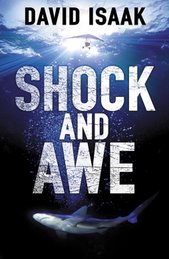
I recall Grumpy Old Bookman remarking with some asperity a while back that a jacket and title ought to damn well give you some idea what the book is about. As discussed in my last post, the title Smite the Waters seems to fall a little short in that department--and I was always hard-pressed to say what possible jacket design would give a clear sense of the book.
Have you seen those crowded, late-60s/early-70s, paperback-original, James-Bond-wannabe covers (usually rather badly drawn)? You know, the ones with some smug after-shave-ad guy in wraparound sunglasses leaning on his sports car with his arms crossed but with a silencer-equipped pistol in one hand, and an overvoluptuous girl in a bikini somewhere, and a variety of weapons scattered about, and a rocket launch in the background, and maybe a little fistfight off to one side and a passionate embrace off to the other, and usually at least one more unlikely item--typically a palm tree or a Chinese dragon or a prowling lion--to suggest the setting?
My novel doesn't have the smug guy or the sports car or bikinis or rocket launches or dragons or lions (though there is indeed a certain amount of violence and even some sex, and if I recall there is the trunk of a dead palm tree.) Unfortunately, there is certainly no single image that would state what the book is "about", and any attempt to convey content in a literal sense would run the risk of--well, see previous paragraph. If I'd had to design my own cover, it would be a mess.
Will Atkins long ago invited me to toss in any ideas I had on this topic, but the best I could do was mumble about how 'something involving water' might be nice. (Well, it was in an e-mail, so the mumbling was with my fingertips, but you know what I mean, don't you?)
Will recently let me have a look at the proposed jacket design. It's still in the development stages--and now I guess it will have a different title slapped down across the jacket art--so I suppose I can't show it yet, and I won't try to describe it except to say it's stunning. (And worked in glorious harmony with the title, I might add.) I've had it up on my screen as the background for some time, and I keep sneaking little glimpses. Nice. (And they've even put my name on it.)
Does it meet the challenge of saying what the book is about? Not directly, though the images draw on the book. Metaphorically, however, I think the design nailed the book with great precision. The novel is a noir piece, much of which nonetheless takes place in harsh sunlight. The designer managed to come up with something that is dark, and also blindingly bright. And wet, too.
But now we have another problem--will our new title suit the great jacket art?
Showing posts with label Smite the Waters. Show all posts
Showing posts with label Smite the Waters. Show all posts
Friday, March 30, 2007


Thursday, March 29, 2007
Smite's Been Smitten. They Smote It. I'm Smat.
Well, we’re almost done with copyediting Smite the Waters, and the process was a breeze. The copyeditor caught some things that definitely needed fixing (most notably someone taking a seat when he was already sitting!), but it’s all been fairly straightforward for me.
It is probably less so for the poor copyeditor. In Michael Stephen Fuch’s The Manuscript (one of the MNW launch titles), the decision was taken to leave the book in American orthography and formatting. In the case of Smite, the spelling and formatting will be changed to British practice (or do I mean practise?) except for certain idiomatic usages. This has to be a fiddly, maddening job, since it isn’t as simple as converting everything in sight from American to British. I’m grateful that it isn’t my job, and someday I’ll buy that copyeditor a drink. Or a whole bottle.
But one minor hitch has emerged. We’re rethinking the title. I like Smite. (Sounds like a slogan—maybe we could hand out I Like Smite buttons?) Will likes Smite. But some of the folks who actually have to sell the darn thing believe that the title doesn’t give much of a clue what the book is about. I have to admit they have a point (and freely grant that they know vastly more about the topic of selling books than I do).
If the title goes, I'll miss it. The phrase has a grand, if puzzling, King Jamesey feel to it, and the words have that simple Anglo-Saxon force that makes me feel one of Hrothgar's minions has swung his meaty arm over my shoulder in a companionable way. And the title might in fact suggest the nature of the story to some--but those who immediately exclaim, "Ah, Exodus 7:20!" are probably not our core audience. DH Lawrence already worked the same ground for the title (and a rather coy title indeed, but those were different times) of his novel Aaron's Rod, but if I add up all the Biblical Fundamentalists and Lawrence scholars who will immediately catch my point, I don't find a big crowd...and I don't find that many thriller readers amongst them. So, I can readily accept the need for a change. But to what?
For a time, my pal David Thayer used An Aztec in Central Park as the working title for every novel he wrote, until the day that title inspired him to include an Aztec character in one of his New York crime novels, and the working title became a permanent title. I’m not sure what Mr. Thayer uses now that Aztec is taken.
I, unfortunately, use the ever-popular Untitled as my working title, so I don’t have any fallback to Smite. Will and I came up with a couple of workable possibilities, but it turns out that both of them have been used. Indeed, our front-runner alternative has been used by a novel coming out about two weeks before mine.
Serendipitously, Roger Morris just handed out a link in his latest post to a pair of essays by Barry Eisler (over on MJ Rose's busy site). Eisler has a wonderful discussion of titles, the first essay focusing on titles with automatic resonance (those that stir an intuitive understanding of what the book is about), and the second on titles with acquired resonance (those that are iconic, and just right, but only become meaningful once you have read the book. Slaughterhouse-Five and Catch-22 would be good examples of acquired resonance--when you first encounter them, you ask what they could possibly mean. I'm afraid Smite the Waters is in that class as well.)
Eisler makes a good case that booksellers lean toward automatic resonance, because it's a sort of sales handle embedded in the book. Acquired resonance is less appealing, especially given that many people in the decision loop will not have read the book themselves. He notes that Dennis Lehane wrote several books titled with automatic resonance before he published Mystic River--and by that point, Lehane's name was enough to sell books.
So, Will and I are off in search of automatic resonance. At least now I know what I'm searching for.
I think the best title anyone ever came up with is attached to Jincy Willett’s hilarious novel Winner of the National Book Award. But she already used that trick. Sigh.
It is probably less so for the poor copyeditor. In Michael Stephen Fuch’s The Manuscript (one of the MNW launch titles), the decision was taken to leave the book in American orthography and formatting. In the case of Smite, the spelling and formatting will be changed to British practice (or do I mean practise?) except for certain idiomatic usages. This has to be a fiddly, maddening job, since it isn’t as simple as converting everything in sight from American to British. I’m grateful that it isn’t my job, and someday I’ll buy that copyeditor a drink. Or a whole bottle.
But one minor hitch has emerged. We’re rethinking the title. I like Smite. (Sounds like a slogan—maybe we could hand out I Like Smite buttons?) Will likes Smite. But some of the folks who actually have to sell the darn thing believe that the title doesn’t give much of a clue what the book is about. I have to admit they have a point (and freely grant that they know vastly more about the topic of selling books than I do).
If the title goes, I'll miss it. The phrase has a grand, if puzzling, King Jamesey feel to it, and the words have that simple Anglo-Saxon force that makes me feel one of Hrothgar's minions has swung his meaty arm over my shoulder in a companionable way. And the title might in fact suggest the nature of the story to some--but those who immediately exclaim, "Ah, Exodus 7:20!" are probably not our core audience. DH Lawrence already worked the same ground for the title (and a rather coy title indeed, but those were different times) of his novel Aaron's Rod, but if I add up all the Biblical Fundamentalists and Lawrence scholars who will immediately catch my point, I don't find a big crowd...and I don't find that many thriller readers amongst them. So, I can readily accept the need for a change. But to what?
For a time, my pal David Thayer used An Aztec in Central Park as the working title for every novel he wrote, until the day that title inspired him to include an Aztec character in one of his New York crime novels, and the working title became a permanent title. I’m not sure what Mr. Thayer uses now that Aztec is taken.
I, unfortunately, use the ever-popular Untitled as my working title, so I don’t have any fallback to Smite. Will and I came up with a couple of workable possibilities, but it turns out that both of them have been used. Indeed, our front-runner alternative has been used by a novel coming out about two weeks before mine.
Serendipitously, Roger Morris just handed out a link in his latest post to a pair of essays by Barry Eisler (over on MJ Rose's busy site). Eisler has a wonderful discussion of titles, the first essay focusing on titles with automatic resonance (those that stir an intuitive understanding of what the book is about), and the second on titles with acquired resonance (those that are iconic, and just right, but only become meaningful once you have read the book. Slaughterhouse-Five and Catch-22 would be good examples of acquired resonance--when you first encounter them, you ask what they could possibly mean. I'm afraid Smite the Waters is in that class as well.)
Eisler makes a good case that booksellers lean toward automatic resonance, because it's a sort of sales handle embedded in the book. Acquired resonance is less appealing, especially given that many people in the decision loop will not have read the book themselves. He notes that Dennis Lehane wrote several books titled with automatic resonance before he published Mystic River--and by that point, Lehane's name was enough to sell books.
So, Will and I are off in search of automatic resonance. At least now I know what I'm searching for.
I think the best title anyone ever came up with is attached to Jincy Willett’s hilarious novel Winner of the National Book Award. But she already used that trick. Sigh.
Thursday, February 15, 2007
How Do You Build a Story? Part II
This is mostly About Me--consider yourself warned--but I'm truly curious about everyone else's working methods.
I don’t plot my stories in advance because I have no idea what the story is until I’m inside it. What I have to begin with is usually some obsession or question, something that is bothering me. In the case of Smite the Waters, it was the problem of Kant’s Categorical Imperative as applied to international terrorism: what would happen to the world if everyone behaved like that?
In the case of al-Qaeda’s attack on the World Trade Center, it was obvious to me that there was no idea of the measured use of force. I have no doubt whatsoever that if bin Laden could have killed more people, he would have done so; indeed, I believe that if he could have killed everyone in New York City, he wouldn’t have hesitated for a moment. What if everyone acted like that? What if groups of Americans decided to act in a similar fashion?
After only a short time, I realized that this question wasn’t terribly intriguing in that form, because to think that way, the characters would have to be so far out of their minds as to be impossible to identify with—and what’s interesting about that?
But suppose their goals were more modest; suppose they decided to fight terrorists with the tools of terror? It is a commonplace that the tools and tactics of the enemy are often adopted, at least to some extent, in any conflict. Why not here?
What would adopting such tactics do to the hearts, minds and souls of the people using them? How would they rationalize their actions (to themselves and to others)? Where would they draw the boundaries on permissible behavior? (For that matter, how would the US government react to overseas terror carried out by Americans?)
For some time I’d had a vague idea of a “wounded warrior” woman as a character, though not for any particular writing project. The burnt-out soldier is a stereotype in fiction about men, but what would the female counterpart be like? Then, one afternoon, the fight-terror-with-terror question collided in my mind with this cloudy character image, and suddenly Carla Smukowski was wandering half-drunk into a porn shop in Portland, Oregon, and the book was off and running. In two days I had the 22 pages of the first chapter (that's many hours at the keyboard, since an hour per page is a blazingly rapid pace for me and two hours per page is more typical), and also had a notion where the story was headed.
Other characters then volunteered, and each brought their own complications, and by the end of the third chapter I realized that once people set off down this kind of road, their plans would naturally grow more grandiose, and that the obvious thing for them to decide was to stop attacking Muslims, and attack Islam itself by obliterating Mecca. An insane idea, perhaps, but one that had resonance.
This new idea—which I suppose most people would now describe as the premise of the novel—required backing up and adding an additional three or four paragraphs to Chapter Two, but needed no other changes. I'd written my first chapters to be fraught with possibilities since I'd been rather unclear as to where the story was heading. (I think that creating a situation fraught with possibilities, both in terms of character and plot, is all one can ask of opening chapters.)
I had spent a great deal of time in various Middle East countries over many years, so the locales required little research; and many of the technical details of nuclear matters and ships (both figure in the plot) were already familiar to me because of my education and work background. (Indeed, it would probably be more accurate to say that what I already knew began steering the story, but it was an unconscious matter.)
Once I have a clear premise and well-defined characters, plot starts writing itself. The ways characters behave—or more specifically, the ways they can behave given their natures—coupled with the logistics of the premise, narrow down the paths the story can follow.
By about page 150 (out of about 500), I knew what the situation of the climax would be (though not how the characters would respond), and the general outline of the plot became inevitable, shaped by what had gone before and the situation toward which we were headed.
In the end, after the first draft, I realized a few things had happened too quickly and easily (something pointed out to me by a number of First Readers), and I had to add some complicating action scenes to the first third and last third of the book. (I did much putting-in and very little cutting in reaching the final form of the book--even though everyone tells me revision is all about cutting). But, with the exception of those calculated additions (and the amendments suggested by my Wiz of an editor, Will Atkins), the plot pretty much wrote itself once the ungainly boat of the novel was launched.
Now, I dearly wish I could have worked all this out on yellow legal pads before writing (see Part I of this post), I really do. But I have no idea who my characters really are until I see them on the page, I have no idea what kind of book I’m writing until I hear the voice of the first chapter, and I can’t know my story until those characters begin interacting with the half-assed concepts swarming in my brain.
If you can do these things without stumbling half-blind into the actual writing of the book, I say, more power to you, and I’m green with envy.
So, How Do You Do That Thing You Do? I’d really like to know how you go about writing a novel. If you have only a few words, drop them into the comment trail, but if you want to give a longer explanation, e-mail it to me. (Or, for those of you who blog, if you want to drop it on your own blog and let me know about it, I’ll link to your post.)
Of course, according to Mr. McKee, I’m lying about all of the foregoing. Better get out those yellow legal pads.
I don’t plot my stories in advance because I have no idea what the story is until I’m inside it. What I have to begin with is usually some obsession or question, something that is bothering me. In the case of Smite the Waters, it was the problem of Kant’s Categorical Imperative as applied to international terrorism: what would happen to the world if everyone behaved like that?
In the case of al-Qaeda’s attack on the World Trade Center, it was obvious to me that there was no idea of the measured use of force. I have no doubt whatsoever that if bin Laden could have killed more people, he would have done so; indeed, I believe that if he could have killed everyone in New York City, he wouldn’t have hesitated for a moment. What if everyone acted like that? What if groups of Americans decided to act in a similar fashion?
After only a short time, I realized that this question wasn’t terribly intriguing in that form, because to think that way, the characters would have to be so far out of their minds as to be impossible to identify with—and what’s interesting about that?
But suppose their goals were more modest; suppose they decided to fight terrorists with the tools of terror? It is a commonplace that the tools and tactics of the enemy are often adopted, at least to some extent, in any conflict. Why not here?
What would adopting such tactics do to the hearts, minds and souls of the people using them? How would they rationalize their actions (to themselves and to others)? Where would they draw the boundaries on permissible behavior? (For that matter, how would the US government react to overseas terror carried out by Americans?)
For some time I’d had a vague idea of a “wounded warrior” woman as a character, though not for any particular writing project. The burnt-out soldier is a stereotype in fiction about men, but what would the female counterpart be like? Then, one afternoon, the fight-terror-with-terror question collided in my mind with this cloudy character image, and suddenly Carla Smukowski was wandering half-drunk into a porn shop in Portland, Oregon, and the book was off and running. In two days I had the 22 pages of the first chapter (that's many hours at the keyboard, since an hour per page is a blazingly rapid pace for me and two hours per page is more typical), and also had a notion where the story was headed.
Other characters then volunteered, and each brought their own complications, and by the end of the third chapter I realized that once people set off down this kind of road, their plans would naturally grow more grandiose, and that the obvious thing for them to decide was to stop attacking Muslims, and attack Islam itself by obliterating Mecca. An insane idea, perhaps, but one that had resonance.
This new idea—which I suppose most people would now describe as the premise of the novel—required backing up and adding an additional three or four paragraphs to Chapter Two, but needed no other changes. I'd written my first chapters to be fraught with possibilities since I'd been rather unclear as to where the story was heading. (I think that creating a situation fraught with possibilities, both in terms of character and plot, is all one can ask of opening chapters.)
I had spent a great deal of time in various Middle East countries over many years, so the locales required little research; and many of the technical details of nuclear matters and ships (both figure in the plot) were already familiar to me because of my education and work background. (Indeed, it would probably be more accurate to say that what I already knew began steering the story, but it was an unconscious matter.)
Once I have a clear premise and well-defined characters, plot starts writing itself. The ways characters behave—or more specifically, the ways they can behave given their natures—coupled with the logistics of the premise, narrow down the paths the story can follow.
By about page 150 (out of about 500), I knew what the situation of the climax would be (though not how the characters would respond), and the general outline of the plot became inevitable, shaped by what had gone before and the situation toward which we were headed.
In the end, after the first draft, I realized a few things had happened too quickly and easily (something pointed out to me by a number of First Readers), and I had to add some complicating action scenes to the first third and last third of the book. (I did much putting-in and very little cutting in reaching the final form of the book--even though everyone tells me revision is all about cutting). But, with the exception of those calculated additions (and the amendments suggested by my Wiz of an editor, Will Atkins), the plot pretty much wrote itself once the ungainly boat of the novel was launched.
Now, I dearly wish I could have worked all this out on yellow legal pads before writing (see Part I of this post), I really do. But I have no idea who my characters really are until I see them on the page, I have no idea what kind of book I’m writing until I hear the voice of the first chapter, and I can’t know my story until those characters begin interacting with the half-assed concepts swarming in my brain.
If you can do these things without stumbling half-blind into the actual writing of the book, I say, more power to you, and I’m green with envy.
So, How Do You Do That Thing You Do? I’d really like to know how you go about writing a novel. If you have only a few words, drop them into the comment trail, but if you want to give a longer explanation, e-mail it to me. (Or, for those of you who blog, if you want to drop it on your own blog and let me know about it, I’ll link to your post.)
Of course, according to Mr. McKee, I’m lying about all of the foregoing. Better get out those yellow legal pads.
Thursday, February 1, 2007
Do Editors Edit? Part II
Jump to Part I
I actually had a good time. I’d look at his suggestions, one by one, saying to myself, “Yes, yes, yes, fuck you, fuck you.”
— Booker Prize-winning novelist Peter Carey on being closely edited for the first time.*
Early on in my days in this silly business (all of about five years ago), a well-known publishing-industry figure advised me: Never admit you’ve been rejected (or that you have unpublished works), as novels are somehow expected to emerge Athena-like in perfected form. (The corollary to this was never to admit you’ve been helped by anyone in any way, as the central myth of the trade is that of the solitary, rebellious, unschooled genius. ) That’s probably sound advice, but, in my unsound fashion, I’ve ignored it.
Roger Morris took transparency to a new level by publishing his first royalty statement. (Roger's second book, the mystery A Gentle Axe, inexplicably retitled "The Gentle Axe" in the US, is on it's way in March over here, so his first royalty statement is probably only a dim memory. It's been all of, what, four months?)
I can’t match Roger on that (and even if I had a royalty statement in hand I might not be inclined to), but I’ll spend a little time talking frankly about getting, well…edited.
My editor, Will Atkins, explained via e-mail that he would be editing me page-by-page, and also might have overarching structural comments, but assured me he expected the editing would be light as the prose was already polished. After we had an agreed-upon text, the manuscript would go on to copyediting, and once that was agreed upon as well, it would go to proofing.
All this sounded like standard operating procedure to me (much the same process a technical book or paper undergoes on its way to the press, and I’d been down that road before), so I sat back, waited, and meanwhile congratulated myself on my polished prose.
I’d like to tell you my prose was polished to such a blinding sheen that when Will sent his suggestions and observations, his only question was why the book wasn’t twice as long. I’d like to tell you that, but I’ll save my fiction for my books.
This is not a complaint. But for any who still doubt that Macmillan New Writing edits their books, let me state this: My editor’s ‘light’ editing consisted of, at my count, 83 specific points, plus another dozen or so general remarks (mostly about acronyms) that brought the total near the century mark. About a hundred points to be addressed. All of this, mind you, prior to copyediting, so we’re not just quibbling about who/whom or unclear pronoun antecedents here.
I’d call that rather attentive editing for a ‘polished’ manuscript (and makes me worry what form ‘heavy’ editing might take.)
Most of these matters could be described as minor—a turn of phrase that rang false, or a description that called attention to itself, or something that might not be clear unless it were read with the attention a lawyer devotes to a contract. A couple of questions were the result of sheer hamhandedness on my part, plain old inattentive writing. And a few were major, affecting a portion of the storyline, and requiring corrective surgery on a whole section or even chapter.
[On top of those items, a few queries were the result of the transatlantic gulf in the English language. In dialogue I sometimes used slang only an American would likely understand. Solving these problems wasn’t straightforward: if an item of American slang is incomprehensible, one can’t put the corresponding British expression into the mouth of an American. An American male does not visit the loo. (He might hit the head, take a leak, see a man about a horse, drain the lizard, feed the goldfish, shake hands with Mister Snakey, or engage in any number of other creative euphemisms, but the ‘loo’ will not be mentioned.)]
There were also passages containing common US acronyms that, Across the Water, must have been as immediately comprehensible as Linear B (and just about as much fun to read).
After banging my head on the floor a few times (by now I was already prone), I arranged these comments in order from Little to Huge, and started addressing them.
Now, I don’t consider my words to be each one fair and gold, which the hand of man ought not to mar, but the sheer number of issues at first took me aback. Hence the horizontal, floor-bound position (see above).
After I started to work though them, however, I saw that every comment was warranted. And then it sank in on me: This guy was on my side. We both had the same goal. He liked the book, and was trying to make it better. In fact, he was working hard to make it better.
(I hear a chorus of, “Well, duhs,” out there. Pipe down.)
It helps that Will Atkins has a sharp sense of humor and yet is quite gentle (the two don’t often go together). When he found the occasional clunker of a sentence, he never asked (as well he might have) whether I’d typed it with my feet, or if instead I’d somehow employed my prehensile tail as well. In one case, where a sentence had all the grace of one of Hannibal’s war elephants tumbling down an Alp in full battle gear, Will merely asked “A little inelegant—can you rephrase?”
I could, I did, I’m glad.
Some points needed discussion to get us in alignment. In one case, after we both contributed our views, I was amused to find we had swapped postions, with Will suggesting we let the original text stand, and I insisting that it needed to be altered for clarity. (If a good editor is confused or bothered by a passage on first reading, there is a very good chance that something is amiss.)
The book's population changed slightly, too. At Will's suggestion, I deleted a minor character who was too obviously there for the convenience of the author (and I then had to figure out some less deus ex machina way of spinning that plot point). Another character who was often referred to got onstage time at Will's suggestion that she deserved a scene. Luckily for me, I already had such a scene (which I had cut, apparently unwisely, in the name of pacing). Will had managed to intuit a textural hole, even though I was sure there was none visible. And one entire piece of technology was obliterated, painlessly (and, if you can toss something painlessly, I think that suggests it oughtn't have been there in the first place).
All in all, it was a great experience, and we now have a better book--especially because of some of his structural suggestions.
So far, I’ve learned many small lessons, but two important ones I'd like to share. First, for those of you who were wondering, MNW indeed edits (and doesn’t charge you--see previous post).
Second, when an editor acquires your manuscript, he is on your side—or, if not on your side, at least on the side of your book, which is what's important. By the time you have an editor, you've probably been through so many adversarial interactions with the publishing industry that you are prepared for more of the same. Relax. Time to take off the Kevlar vest, lower your porcupine quills, realign those brainwaves from spiky beta to smooth alpha. You have an ally now.
Writing is a lonely affair; the editing process is your one chance to collaborate with someone, and, if you're lucky enough to get a good editor, this can be one of the most rewarding parts of writing the book.
Enjoy it. After you get up off the floor, that is.
*[The Peter Carey quote is from Ben Yagoda’s wonderful meditation on style, The Sound on the Page. Great book—and, rather appropriately, quite stylish itself.]
Jump to Part I
I actually had a good time. I’d look at his suggestions, one by one, saying to myself, “Yes, yes, yes, fuck you, fuck you.”
— Booker Prize-winning novelist Peter Carey on being closely edited for the first time.*
Early on in my days in this silly business (all of about five years ago), a well-known publishing-industry figure advised me: Never admit you’ve been rejected (or that you have unpublished works), as novels are somehow expected to emerge Athena-like in perfected form. (The corollary to this was never to admit you’ve been helped by anyone in any way, as the central myth of the trade is that of the solitary, rebellious, unschooled genius. ) That’s probably sound advice, but, in my unsound fashion, I’ve ignored it.
Roger Morris took transparency to a new level by publishing his first royalty statement. (Roger's second book, the mystery A Gentle Axe, inexplicably retitled "The Gentle Axe" in the US, is on it's way in March over here, so his first royalty statement is probably only a dim memory. It's been all of, what, four months?)
I can’t match Roger on that (and even if I had a royalty statement in hand I might not be inclined to), but I’ll spend a little time talking frankly about getting, well…edited.
My editor, Will Atkins, explained via e-mail that he would be editing me page-by-page, and also might have overarching structural comments, but assured me he expected the editing would be light as the prose was already polished. After we had an agreed-upon text, the manuscript would go on to copyediting, and once that was agreed upon as well, it would go to proofing.
All this sounded like standard operating procedure to me (much the same process a technical book or paper undergoes on its way to the press, and I’d been down that road before), so I sat back, waited, and meanwhile congratulated myself on my polished prose.
I’d like to tell you my prose was polished to such a blinding sheen that when Will sent his suggestions and observations, his only question was why the book wasn’t twice as long. I’d like to tell you that, but I’ll save my fiction for my books.
This is not a complaint. But for any who still doubt that Macmillan New Writing edits their books, let me state this: My editor’s ‘light’ editing consisted of, at my count, 83 specific points, plus another dozen or so general remarks (mostly about acronyms) that brought the total near the century mark. About a hundred points to be addressed. All of this, mind you, prior to copyediting, so we’re not just quibbling about who/whom or unclear pronoun antecedents here.
I’d call that rather attentive editing for a ‘polished’ manuscript (and makes me worry what form ‘heavy’ editing might take.)
Most of these matters could be described as minor—a turn of phrase that rang false, or a description that called attention to itself, or something that might not be clear unless it were read with the attention a lawyer devotes to a contract. A couple of questions were the result of sheer hamhandedness on my part, plain old inattentive writing. And a few were major, affecting a portion of the storyline, and requiring corrective surgery on a whole section or even chapter.
[On top of those items, a few queries were the result of the transatlantic gulf in the English language. In dialogue I sometimes used slang only an American would likely understand. Solving these problems wasn’t straightforward: if an item of American slang is incomprehensible, one can’t put the corresponding British expression into the mouth of an American. An American male does not visit the loo. (He might hit the head, take a leak, see a man about a horse, drain the lizard, feed the goldfish, shake hands with Mister Snakey, or engage in any number of other creative euphemisms, but the ‘loo’ will not be mentioned.)]
There were also passages containing common US acronyms that, Across the Water, must have been as immediately comprehensible as Linear B (and just about as much fun to read).
After banging my head on the floor a few times (by now I was already prone), I arranged these comments in order from Little to Huge, and started addressing them.
Now, I don’t consider my words to be each one fair and gold, which the hand of man ought not to mar, but the sheer number of issues at first took me aback. Hence the horizontal, floor-bound position (see above).
After I started to work though them, however, I saw that every comment was warranted. And then it sank in on me: This guy was on my side. We both had the same goal. He liked the book, and was trying to make it better. In fact, he was working hard to make it better.
(I hear a chorus of, “Well, duhs,” out there. Pipe down.)
It helps that Will Atkins has a sharp sense of humor and yet is quite gentle (the two don’t often go together). When he found the occasional clunker of a sentence, he never asked (as well he might have) whether I’d typed it with my feet, or if instead I’d somehow employed my prehensile tail as well. In one case, where a sentence had all the grace of one of Hannibal’s war elephants tumbling down an Alp in full battle gear, Will merely asked “A little inelegant—can you rephrase?”
I could, I did, I’m glad.
Some points needed discussion to get us in alignment. In one case, after we both contributed our views, I was amused to find we had swapped postions, with Will suggesting we let the original text stand, and I insisting that it needed to be altered for clarity. (If a good editor is confused or bothered by a passage on first reading, there is a very good chance that something is amiss.)
The book's population changed slightly, too. At Will's suggestion, I deleted a minor character who was too obviously there for the convenience of the author (and I then had to figure out some less deus ex machina way of spinning that plot point). Another character who was often referred to got onstage time at Will's suggestion that she deserved a scene. Luckily for me, I already had such a scene (which I had cut, apparently unwisely, in the name of pacing). Will had managed to intuit a textural hole, even though I was sure there was none visible. And one entire piece of technology was obliterated, painlessly (and, if you can toss something painlessly, I think that suggests it oughtn't have been there in the first place).
All in all, it was a great experience, and we now have a better book--especially because of some of his structural suggestions.
So far, I’ve learned many small lessons, but two important ones I'd like to share. First, for those of you who were wondering, MNW indeed edits (and doesn’t charge you--see previous post).
Second, when an editor acquires your manuscript, he is on your side—or, if not on your side, at least on the side of your book, which is what's important. By the time you have an editor, you've probably been through so many adversarial interactions with the publishing industry that you are prepared for more of the same. Relax. Time to take off the Kevlar vest, lower your porcupine quills, realign those brainwaves from spiky beta to smooth alpha. You have an ally now.
Writing is a lonely affair; the editing process is your one chance to collaborate with someone, and, if you're lucky enough to get a good editor, this can be one of the most rewarding parts of writing the book.
Enjoy it. After you get up off the floor, that is.
*[The Peter Carey quote is from Ben Yagoda’s wonderful meditation on style, The Sound on the Page. Great book—and, rather appropriately, quite stylish itself.]
Jump to Part I
Tuesday, January 30, 2007
Do Editors Edit? Part I
Jump to Part II
The Conventional Wisdom
If you spend any time listening to talks by literary agents or browsing through books on the writing business, you will soon hear that the days of intensive editing are long gone. No more, the agents caution, will a manuscript less than letter-perfect catch the attention of an editor. Agent (and former editor) Lori Perkins says, “The description of what a good editor once did is now the definition of what a good agent can do.” We are given to understand that if Maxwell Perkins (no relationship to Lori, so far as I can ascertain) were still alive, he would be working as an agent, not an editor.
Move a little further down the food chain, however, and you will be told your manuscript must be polished before it even arrives on the desk of an agent. Agent Noah Lukeman writes, “Agents and editors don’t read manuscripts to enjoy them; they read solely with the goal of getting through the pile, solely with an eye to dismiss a manuscript—and believe me, they’ll look for any reason they can, down to the last letter.” Despite Lori Perkins’ comment above, at conferences every session on getting an agent emphasizes you can’t send a manuscript to an agent if it still needs work.
That any manuscript a writer sends out ought to be close to publishable seems self-evident. Isn’t that the writer’s job in the first place? An agent or editor may make suggestions to make a manuscript a better book, but it ought to be a good book before they set eyes upon it. Right?
When Michael Barnard announced the launch of Macmillan New Writing, he made it clear they would not be acquiring works that required massive editing. This seems in line with the policies of virtually every commercial publishing house—are there any houses that are searching for books that are promising but far from being publishable? (If so, those houses ought to speak up, as agents routinely reject such books. There’s plenty available.)
Tempest in a Thimble
Apparently, many considered Barnard’s observations outrageous. In some places his remarks were willfully misconstrued, while in other venues people put forth wholly imaginary scenarios of what MNW planned to do…and then worked themselves into an apoplectic fit about their own conjectures.
In effect, some folks asserted that Macmillan planned to dump books directly from the slush pile onto the market with hardly a glance at the content. One somewhat hysterical observer argued—on the basis of no discernible evidence—that the MNW process would "take away the exercise of taste and judgment from publishing", as though Macmillan planned to print every manuscript hurled into their offices, and as if the only defenders of "taste and judgment" in publishing were the literary agents. (It isn't explained why any publisher would choose to make huge investments in well-produced hardback volumes without at least skimming the manuscripts before send them off for typesetting.)
At the same time, there were assertions that Macmillan would only publish books where the authors paid from their own pockets for editing services. (I’ve seen some recent bestsellers where someone, somewhere ought to have paid for editing services—and possibly even for remedial classes in composition—but that’s another matter.)
With all this noise over editing—or rather over the lack thereof—I was very curious indeed to see how MNW would approach the editing process on Smite the Waters. Would they demand that jail be rewritten as gaol? (I hoped not, as there are some things to which I will not stoop. Not many, but a couple, and once you give in on gaol, you’ll have them insisting on whisky as uisge, and then they'll be improvising--it'll be whale as uiol, and lord knows how you’ll be expected to render James Joyce. It’s this sort of thing, and not the tea tax, that precipitated the American Revolution.)
I’d never taken seriously the idea that, as some had speculated, I’d be charged for editing services by my publisher, since there was no mention of the concept in the contract. And how could such a thing work? Would I be charged (ka-ching!) every time the editor scribbled awk! or wd chce? or sent frag in the margin of my manuscript? (I’d be in trouble, as I’m known for awk sent frags, and odd wd chces, which together form an admittedly shaky pillar of my so-called style.) Would a single Post-It note reading Unclear Eleanor’s motivation re: speaking Count at manor re: Rudolfo’s parentage cost me fifty bucks (or, even worse, fifty pounds)?
As I waited to find out, I trembled, and not only for myself. No, I feared for Rudolfo and Eleanor as well.
Well, I at least maintained a lively interest. And if you want to know what happens in MNW editing, you’ll have to read the my next post. (And if you figure out who Rudolfo and Eleanor are, let me know.)
Jump to Part II
The Conventional Wisdom
If you spend any time listening to talks by literary agents or browsing through books on the writing business, you will soon hear that the days of intensive editing are long gone. No more, the agents caution, will a manuscript less than letter-perfect catch the attention of an editor. Agent (and former editor) Lori Perkins says, “The description of what a good editor once did is now the definition of what a good agent can do.” We are given to understand that if Maxwell Perkins (no relationship to Lori, so far as I can ascertain) were still alive, he would be working as an agent, not an editor.
Move a little further down the food chain, however, and you will be told your manuscript must be polished before it even arrives on the desk of an agent. Agent Noah Lukeman writes, “Agents and editors don’t read manuscripts to enjoy them; they read solely with the goal of getting through the pile, solely with an eye to dismiss a manuscript—and believe me, they’ll look for any reason they can, down to the last letter.” Despite Lori Perkins’ comment above, at conferences every session on getting an agent emphasizes you can’t send a manuscript to an agent if it still needs work.
That any manuscript a writer sends out ought to be close to publishable seems self-evident. Isn’t that the writer’s job in the first place? An agent or editor may make suggestions to make a manuscript a better book, but it ought to be a good book before they set eyes upon it. Right?
When Michael Barnard announced the launch of Macmillan New Writing, he made it clear they would not be acquiring works that required massive editing. This seems in line with the policies of virtually every commercial publishing house—are there any houses that are searching for books that are promising but far from being publishable? (If so, those houses ought to speak up, as agents routinely reject such books. There’s plenty available.)
Tempest in a Thimble
Apparently, many considered Barnard’s observations outrageous. In some places his remarks were willfully misconstrued, while in other venues people put forth wholly imaginary scenarios of what MNW planned to do…and then worked themselves into an apoplectic fit about their own conjectures.
In effect, some folks asserted that Macmillan planned to dump books directly from the slush pile onto the market with hardly a glance at the content. One somewhat hysterical observer argued—on the basis of no discernible evidence—that the MNW process would "take away the exercise of taste and judgment from publishing", as though Macmillan planned to print every manuscript hurled into their offices, and as if the only defenders of "taste and judgment" in publishing were the literary agents. (It isn't explained why any publisher would choose to make huge investments in well-produced hardback volumes without at least skimming the manuscripts before send them off for typesetting.)
At the same time, there were assertions that Macmillan would only publish books where the authors paid from their own pockets for editing services. (I’ve seen some recent bestsellers where someone, somewhere ought to have paid for editing services—and possibly even for remedial classes in composition—but that’s another matter.)
With all this noise over editing—or rather over the lack thereof—I was very curious indeed to see how MNW would approach the editing process on Smite the Waters. Would they demand that jail be rewritten as gaol? (I hoped not, as there are some things to which I will not stoop. Not many, but a couple, and once you give in on gaol, you’ll have them insisting on whisky as uisge, and then they'll be improvising--it'll be whale as uiol, and lord knows how you’ll be expected to render James Joyce. It’s this sort of thing, and not the tea tax, that precipitated the American Revolution.)
I’d never taken seriously the idea that, as some had speculated, I’d be charged for editing services by my publisher, since there was no mention of the concept in the contract. And how could such a thing work? Would I be charged (ka-ching!) every time the editor scribbled awk! or wd chce? or sent frag in the margin of my manuscript? (I’d be in trouble, as I’m known for awk sent frags, and odd wd chces, which together form an admittedly shaky pillar of my so-called style.) Would a single Post-It note reading Unclear Eleanor’s motivation re: speaking Count at manor re: Rudolfo’s parentage cost me fifty bucks (or, even worse, fifty pounds)?
As I waited to find out, I trembled, and not only for myself. No, I feared for Rudolfo and Eleanor as well.
Well, I at least maintained a lively interest. And if you want to know what happens in MNW editing, you’ll have to read the my next post. (And if you figure out who Rudolfo and Eleanor are, let me know.)
Jump to Part II
Friday, January 19, 2007
The Road to Macmillan New Writing, Part II
Jump to Part I
Go East, Young Man
Having parted from my New York agent, there was nothing for it but to try and get an agent…again…this time in the UK. I went to a local philatelist and bought enough UK stamps to pay for a dozen SASEs, went to the post office and bought a dozen International Priority Mail envelopes and stamps, and settled in to query a few UK literary agents.
Meanwhile, back at stately Wayne Manor…
A couple of years back, Michael Barnard, with the enthusiastic support of Pan Macmillan publisher Richard Charkin, decided to start Macmillan New Writing. Although in many ways the terms set by MNW are little more than a return to traditional publishing practices, the howl that came from the industry—agents, pundits, and even a few novelists (who damn well ought to have known better)—carried right across the Atlantic.
For those of you who somehow missed that shitstorm, here are two of the opening salvos in the battle, the first one critical of MNW, the second favorable.
My sympathies from the start were with Michael Allen (Grumpy Old Bookman), whose attitude seemed to be nothing more than sensible and pragmatic. (A little grumpy, sure, but who isn’t?) Anything that subverted or sidestepped the current so-called system without venturing into the realm of self-publishing seemed to me like progress. (If you want to read more about the genesis of MNW, pick up a copy of Barnard’s Transparent Imprint. All proceeds go to charity.)
The MNW plan sounded like a damn good idea to me, and I was jealous that no American publisher had that kind of vision; but for a few months Macmillan-bashing was a hot new sport on the web. This dwindled after the facts about MNW's plans turned out not to match the wild accusations critics had created out of thin air. Authors will pay for editing! (No, Macmillan has its own editorial staff and pays them itself.) The books will all be cheap PODs! (They are traditionally printed hardbacks, and better produced than most.) They'll accept anything that comes in! (MNW accepts about 0.3% of the manuscripts submitted, or about 3 in every thousand.) There will be a flood of novels! (Yes--if you consider 12 new books a year a flood.) No bookstores will carry them! (They do.) No legitimate sources will review them! (There have probably been more reviews than for most debut novels, and reviews have come from sources up to and including the Times Literary Supplement.)
The only element of controversy that was correct is that they pay no advances against royalites (though they pay a 20% royalty on the sales that are made).
Once the pundits realized their conjectures had nothing to do with reality, things grew quieter. Some damage was done as some people never learned the accusations were false. On the other hand, it did generate publicity, and gained the venture support from some surprising sources, including the buying manager of one of the major UK book chains.
Back when I was still planning on selling Smite in the US, MNW had offered the first six launch titles for 50% off the cover price. I ordered them. It was a slow boat that brought them to our shores, but the books were good. I dashed through Roger Morris’s Taking Comfort (effing brilliant!) and then started into Fuchs’ fast-paced existential thriller The Manuscript, followed by Conor Corderoy’s eclectic crossgenre Dark Rain (which is so cinematic I’m surprised Terry Gilliam hasn’t snapped it up). Brian Martin’s North was elegant and recalled for me the repressed, moody sexuality of John Fowles, and Cate Sweeney’s Selfish Jean had me snorting coffee out my nose (her “letting the wine breathe” scene was so funny I read it aloud to my long-suffering POSSLQ Pamela. [Pronounced possel-queue. Person of Opposite Sex Sharing Living Quarters according to the Census Bureau, those incurable romantics.]) Finally, Suroopa Mukherjee’s Across the Mystic Shore accomplished what the novel does better than any other medium by taking me into someone else’s worldview.
Hell, this was the most fun I’d had with a seemingly random set of books since my grade-school teacher first took us to the library. I cursed the accidents of fate that had me born in America when such fun was to be had back in the Motherland. (Ignore my surname, I’m from a long line of Drakes and Davidsons. It’s a long story—and yet surprisingly uninteresting.)
It seemed unlikely to me that MNW would accept an American author. Mind you, there was nothing official stating they wouldn’t, but my former agent had told me I had little chance of publication in the UK, and there were a number of UK agents who stated upfront that they under no circumstances acted as primary agents for writers based in the United States. Perhaps the idea of literary asylum in the UK was a dead ideal. Yet I'd been told the only things that stood between me and publication in the US were that the bad guys were Americans, and there was no real hero…and Smite seemed like a publishable book…
What the hell. I sent my novel off to Macmillan New Writing. The worst that could happen was rejection, and rejection in this business is the norm. I also mailed off a few query letters to UK agents, and got back to work on another novel.
I was on travel when Pamela called to tell me I’d received an e-mail from Will Atkins, MNW’s editor. She read it to me over the phone. It opened by saying some very complimentary things about the book, and I began to feel queasy—in my experience, kind words were typically a prologue to Unfortunately, however…
Instead, to my astonishment, the message went on to say MNW would be delighted to publish Smite. Delighted? I would have settled for Grudgingly willing. I made Pamela read it again, and again, and even asked her to forward the e-mail to a nearby computer so I could read it myself. There was no small print, no maybes—I was being offered publication by one of the world’s great houses.
Did I say yes? Does Spring follow Winter, and doth pride, like Summer, goeth before a Fall, and does ontogeny really recapitulate phylogeny? (And will this be on the exam?)
The book is due for launch in September, 2007, about three years after I finished writing it, and I couldn’t be happier with my publisher.
Jump to Part I
Go East, Young Man
Having parted from my New York agent, there was nothing for it but to try and get an agent…again…this time in the UK. I went to a local philatelist and bought enough UK stamps to pay for a dozen SASEs, went to the post office and bought a dozen International Priority Mail envelopes and stamps, and settled in to query a few UK literary agents.
Meanwhile, back at stately Wayne Manor…
A couple of years back, Michael Barnard, with the enthusiastic support of Pan Macmillan publisher Richard Charkin, decided to start Macmillan New Writing. Although in many ways the terms set by MNW are little more than a return to traditional publishing practices, the howl that came from the industry—agents, pundits, and even a few novelists (who damn well ought to have known better)—carried right across the Atlantic.
For those of you who somehow missed that shitstorm, here are two of the opening salvos in the battle, the first one critical of MNW, the second favorable.
My sympathies from the start were with Michael Allen (Grumpy Old Bookman), whose attitude seemed to be nothing more than sensible and pragmatic. (A little grumpy, sure, but who isn’t?) Anything that subverted or sidestepped the current so-called system without venturing into the realm of self-publishing seemed to me like progress. (If you want to read more about the genesis of MNW, pick up a copy of Barnard’s Transparent Imprint. All proceeds go to charity.)
The MNW plan sounded like a damn good idea to me, and I was jealous that no American publisher had that kind of vision; but for a few months Macmillan-bashing was a hot new sport on the web. This dwindled after the facts about MNW's plans turned out not to match the wild accusations critics had created out of thin air. Authors will pay for editing! (No, Macmillan has its own editorial staff and pays them itself.) The books will all be cheap PODs! (They are traditionally printed hardbacks, and better produced than most.) They'll accept anything that comes in! (MNW accepts about 0.3% of the manuscripts submitted, or about 3 in every thousand.) There will be a flood of novels! (Yes--if you consider 12 new books a year a flood.) No bookstores will carry them! (They do.) No legitimate sources will review them! (There have probably been more reviews than for most debut novels, and reviews have come from sources up to and including the Times Literary Supplement.)
The only element of controversy that was correct is that they pay no advances against royalites (though they pay a 20% royalty on the sales that are made).
Once the pundits realized their conjectures had nothing to do with reality, things grew quieter. Some damage was done as some people never learned the accusations were false. On the other hand, it did generate publicity, and gained the venture support from some surprising sources, including the buying manager of one of the major UK book chains.
Back when I was still planning on selling Smite in the US, MNW had offered the first six launch titles for 50% off the cover price. I ordered them. It was a slow boat that brought them to our shores, but the books were good. I dashed through Roger Morris’s Taking Comfort (effing brilliant!) and then started into Fuchs’ fast-paced existential thriller The Manuscript, followed by Conor Corderoy’s eclectic crossgenre Dark Rain (which is so cinematic I’m surprised Terry Gilliam hasn’t snapped it up). Brian Martin’s North was elegant and recalled for me the repressed, moody sexuality of John Fowles, and Cate Sweeney’s Selfish Jean had me snorting coffee out my nose (her “letting the wine breathe” scene was so funny I read it aloud to my long-suffering POSSLQ Pamela. [Pronounced possel-queue. Person of Opposite Sex Sharing Living Quarters according to the Census Bureau, those incurable romantics.]) Finally, Suroopa Mukherjee’s Across the Mystic Shore accomplished what the novel does better than any other medium by taking me into someone else’s worldview.
Hell, this was the most fun I’d had with a seemingly random set of books since my grade-school teacher first took us to the library. I cursed the accidents of fate that had me born in America when such fun was to be had back in the Motherland. (Ignore my surname, I’m from a long line of Drakes and Davidsons. It’s a long story—and yet surprisingly uninteresting.)
It seemed unlikely to me that MNW would accept an American author. Mind you, there was nothing official stating they wouldn’t, but my former agent had told me I had little chance of publication in the UK, and there were a number of UK agents who stated upfront that they under no circumstances acted as primary agents for writers based in the United States. Perhaps the idea of literary asylum in the UK was a dead ideal. Yet I'd been told the only things that stood between me and publication in the US were that the bad guys were Americans, and there was no real hero…and Smite seemed like a publishable book…
What the hell. I sent my novel off to Macmillan New Writing. The worst that could happen was rejection, and rejection in this business is the norm. I also mailed off a few query letters to UK agents, and got back to work on another novel.
I was on travel when Pamela called to tell me I’d received an e-mail from Will Atkins, MNW’s editor. She read it to me over the phone. It opened by saying some very complimentary things about the book, and I began to feel queasy—in my experience, kind words were typically a prologue to Unfortunately, however…
Instead, to my astonishment, the message went on to say MNW would be delighted to publish Smite. Delighted? I would have settled for Grudgingly willing. I made Pamela read it again, and again, and even asked her to forward the e-mail to a nearby computer so I could read it myself. There was no small print, no maybes—I was being offered publication by one of the world’s great houses.
Did I say yes? Does Spring follow Winter, and doth pride, like Summer, goeth before a Fall, and does ontogeny really recapitulate phylogeny? (And will this be on the exam?)
The book is due for launch in September, 2007, about three years after I finished writing it, and I couldn’t be happier with my publisher.
Jump to Part I
Wednesday, January 17, 2007
The Road to Macmillan New Writing, Part I
Jump to Part II
Getting and Losing an Agent
Why is an American publishing his novel with Macmillan New Writing? After all, I reside in the US of A, where we have publishers of our own (Admittedly they mainly sell diet books, with the occasional novel by Nicole Richie or Pamela Anderson, but they are publishers nonetheless. No, really.)
Actually, I’m not the first American to publish with MNW. That would be Michael Stephen Fuchs, whose excellent novel The Manuscript was one of the six MNW launch titles. And it’s been slated for US publication, and UK paperback, and optioned for film, and deservedly so. But Michael lives and works in London, so he’s one of the locals.
So what’s my excuse?
Glad you asked. Gather round, kiddies, and after he secures the perimeter to prevent escape, Uncle David will explain.
In 2004 I completed Smite the Waters, a novel about a group of Americans who decide to fight terror with terror. (Spoiler: Their ultimate plan is to nuke Mecca.)
Now, before you get riled and start sending hate mail, let me note that this isn’t a jingoistic, flag-waving fantasy where untainted, home-bred good conquers unmitigated foreign evil It’s more in the nature of a cautionary tale. I suppose it’s a “thriller,” and perhaps even a “technothriller,” but its ancestors are more Graham Greene than Tom Clancy.
I admit Smite isn’t easy to pigeonhole. There are two protagonists. There are five points of view, and, although there is a noir tone overall, the book also has a heaping helping of techno-candy, and even some caper elements. It abounds in moral ambiguity and nuance, and is more character-driven than most recent thrillers. A description of the story line sounds like (wince) Men’s Adventure, but the embittered female soldier who leads the terrorists is the book’s main selling point. Despite all those facts ("features" to me, "drawbacks" to most of the publishing industry) it wasn’t hard to find representation—two excellent literary agents simultaneously offered to take me on while seven others were still reading. To someone with a couple of previous novels sitting in my drawer (good novels, I hasten to add, but perhaps a touch too quirky for the market), it seemed as though I’d finally arrived.
My agent was a good one—well-connected, and able to go directly to the high-level folks at each house who could flip on the green light.
Those green lights all stayed red. I’d heard of being damned with faint praise, but the rejections we received damned the book with effusive praise. They loved the characters, the plot hook, the prose, the pacing…at any moment, I expected to hear that someone loved my 12-point Times New Roman. There were just two tiny, but fatal, problems.
One editor came right out and said it, after larding on the compliments: “The fact that the bad guys are Americans makes this a hard sell for us.” There were variations on this message, most of them more subtle, but the overwhelming response was that New York was shying away from “9/11 fiction” in “the present climate,” and it was explained that if they went down that road they wanted a “real hero” to “lead the narrative charge.”
Another editor even offered that she was sure she “would be kicking myself for turning this down.” (I haven’t yet checked to see if she’d like me to save her the work by dropping by and kicking her myself, but if she happens to read this—hey, I’m willing.)
By the end of 2005, my agent was giving up on the book. Not on me, bless her heart—she wanted to pick up another of my earlier books and get to work—but after only a handful of rejections, she’d decided that the subject matter and the characters of Smite would preclude publication.
I’d been steeped in the tales of folks like James Lee Burke, whose breakout novel was rejected by 111 editors, so less than ten rejections struck me as barely having begun. Not so, my agent counseled—this was “a big, commercial book” and only a few houses could “give it what it needed” in terms of distribution and promotion. She refused to consider smaller presses; she refused to consider more literary imprints, even though the lack of a “real hero” and the ensemble nature of the book made it a touch more thoughtful than many thrillers.
Fine. Over the years I’d heard of many fine American writers who had to go overseas to publish. John Knowles’ A Separate Peace, now considered a classic, was turned down everywhere in the US before it was published in England; James Purdy’s novels were all considered unpublishable in America until he’d built up a body of work in Europe; folks like Chester Himes and Jonathan Carroll finally moved to Europe altogether because they were appreciated abroad and comparatively ignored at home. More recent debuts by Americans like Carol O’Connell’s Mallory books also found a home in the UK before NY publishers would touch them.
I asked two friends, who are well-established American novelists, if I were crazy to consider publishing in the UK. Neither of them thought it odd—and both of them informed me that their UK sales were typically twice their US sales.
I asked other friends, and they laughed. The general impression they gave me was that “The fact that the bad guys are Americans” would make no difference in Europe, and might even be a selling point.
So, I asked my agent if she would try to sell Smite the Waters to houses in the UK. Her agency boasted outstanding overseas connections, so I expected at least a few trial submissions. Instead, she told me that my book was far “too American” to be of interest to any publisher in the UK
I think there often comes a time for writers—usually long after the process of writing is over—when it isn’t about you, the author, any more, but instead about the novel. What do you owe the book? I thought Smite needed to be given a real chance.
But it’s nerve-wracking for an unpublished novelist to drop an agent voluntarily. After your novel’s been shopped to the top half-dozen NY houses, no other agent is going to want to pick you up. Unagented, you have no track record; agented but unsold, you have a negative track record, because your other agent has already, to use the industry’s charming term, “pissed in all the ponds.”
I contacted my agent and said I wasn’t ready to give up on Smite. She said she understood, added that it really was a good book, and wished me luck.
And so we parted company. Many writers have compared leaving their agent to getting divorced. If so, it’s a strange sort of divorce, as the agent still has dozens of other spouses. It’s more like leaving someone’s harem…except that you no longer have the admittedly limited advantages of your virginity.
Jump to Part II
Getting and Losing an Agent
Why is an American publishing his novel with Macmillan New Writing? After all, I reside in the US of A, where we have publishers of our own (Admittedly they mainly sell diet books, with the occasional novel by Nicole Richie or Pamela Anderson, but they are publishers nonetheless. No, really.)
Actually, I’m not the first American to publish with MNW. That would be Michael Stephen Fuchs, whose excellent novel The Manuscript was one of the six MNW launch titles. And it’s been slated for US publication, and UK paperback, and optioned for film, and deservedly so. But Michael lives and works in London, so he’s one of the locals.
So what’s my excuse?
Glad you asked. Gather round, kiddies, and after he secures the perimeter to prevent escape, Uncle David will explain.
In 2004 I completed Smite the Waters, a novel about a group of Americans who decide to fight terror with terror. (Spoiler: Their ultimate plan is to nuke Mecca.)
Now, before you get riled and start sending hate mail, let me note that this isn’t a jingoistic, flag-waving fantasy where untainted, home-bred good conquers unmitigated foreign evil It’s more in the nature of a cautionary tale. I suppose it’s a “thriller,” and perhaps even a “technothriller,” but its ancestors are more Graham Greene than Tom Clancy.
I admit Smite isn’t easy to pigeonhole. There are two protagonists. There are five points of view, and, although there is a noir tone overall, the book also has a heaping helping of techno-candy, and even some caper elements. It abounds in moral ambiguity and nuance, and is more character-driven than most recent thrillers. A description of the story line sounds like (wince) Men’s Adventure, but the embittered female soldier who leads the terrorists is the book’s main selling point. Despite all those facts ("features" to me, "drawbacks" to most of the publishing industry) it wasn’t hard to find representation—two excellent literary agents simultaneously offered to take me on while seven others were still reading. To someone with a couple of previous novels sitting in my drawer (good novels, I hasten to add, but perhaps a touch too quirky for the market), it seemed as though I’d finally arrived.
My agent was a good one—well-connected, and able to go directly to the high-level folks at each house who could flip on the green light.
Those green lights all stayed red. I’d heard of being damned with faint praise, but the rejections we received damned the book with effusive praise. They loved the characters, the plot hook, the prose, the pacing…at any moment, I expected to hear that someone loved my 12-point Times New Roman. There were just two tiny, but fatal, problems.
One editor came right out and said it, after larding on the compliments: “The fact that the bad guys are Americans makes this a hard sell for us.” There were variations on this message, most of them more subtle, but the overwhelming response was that New York was shying away from “9/11 fiction” in “the present climate,” and it was explained that if they went down that road they wanted a “real hero” to “lead the narrative charge.”
Another editor even offered that she was sure she “would be kicking myself for turning this down.” (I haven’t yet checked to see if she’d like me to save her the work by dropping by and kicking her myself, but if she happens to read this—hey, I’m willing.)
By the end of 2005, my agent was giving up on the book. Not on me, bless her heart—she wanted to pick up another of my earlier books and get to work—but after only a handful of rejections, she’d decided that the subject matter and the characters of Smite would preclude publication.
I’d been steeped in the tales of folks like James Lee Burke, whose breakout novel was rejected by 111 editors, so less than ten rejections struck me as barely having begun. Not so, my agent counseled—this was “a big, commercial book” and only a few houses could “give it what it needed” in terms of distribution and promotion. She refused to consider smaller presses; she refused to consider more literary imprints, even though the lack of a “real hero” and the ensemble nature of the book made it a touch more thoughtful than many thrillers.
Fine. Over the years I’d heard of many fine American writers who had to go overseas to publish. John Knowles’ A Separate Peace, now considered a classic, was turned down everywhere in the US before it was published in England; James Purdy’s novels were all considered unpublishable in America until he’d built up a body of work in Europe; folks like Chester Himes and Jonathan Carroll finally moved to Europe altogether because they were appreciated abroad and comparatively ignored at home. More recent debuts by Americans like Carol O’Connell’s Mallory books also found a home in the UK before NY publishers would touch them.
I asked two friends, who are well-established American novelists, if I were crazy to consider publishing in the UK. Neither of them thought it odd—and both of them informed me that their UK sales were typically twice their US sales.
I asked other friends, and they laughed. The general impression they gave me was that “The fact that the bad guys are Americans” would make no difference in Europe, and might even be a selling point.
So, I asked my agent if she would try to sell Smite the Waters to houses in the UK. Her agency boasted outstanding overseas connections, so I expected at least a few trial submissions. Instead, she told me that my book was far “too American” to be of interest to any publisher in the UK
I think there often comes a time for writers—usually long after the process of writing is over—when it isn’t about you, the author, any more, but instead about the novel. What do you owe the book? I thought Smite needed to be given a real chance.
But it’s nerve-wracking for an unpublished novelist to drop an agent voluntarily. After your novel’s been shopped to the top half-dozen NY houses, no other agent is going to want to pick you up. Unagented, you have no track record; agented but unsold, you have a negative track record, because your other agent has already, to use the industry’s charming term, “pissed in all the ponds.”
I contacted my agent and said I wasn’t ready to give up on Smite. She said she understood, added that it really was a good book, and wished me luck.
And so we parted company. Many writers have compared leaving their agent to getting divorced. If so, it’s a strange sort of divorce, as the agent still has dozens of other spouses. It’s more like leaving someone’s harem…except that you no longer have the admittedly limited advantages of your virginity.
Jump to Part II
Subscribe to:
Posts (Atom)