Friday, May 11, 2007

Non-MNW Books by Macmillan New Writers: Part 2 of 2


It would have been hard to talk about The Gentle Axe without mentioning Crime and Punishment.

In contrast, it would be quite easy to talk about Aliya Whiteley’s novella Mean Mode Median without mentioning Frank Herbert’s Dune, and you can certainly read her book with immense enjoyment even if you haven’t the slightest interest in the Kwisatz Haderach (you barbarian). Her characters are iconic yet immediately believable, and the short reference to Dune is a mere footnote to her story (though it's a footnote that provides a perfect key).

Some critics claim the novella is the pinnacle of fictional forms, and I’m inclined to agree (even though I couldn't write one to save my life): it can have the intensity and perfection of a short story, but with some of the breathing space and breadth of a novel. What is most surprising about Mean Mode Median is that, like Aliya’s Three Things About Me, it employs multiple POVs—common enough in a novel, but risky in the more compressed form of the novella; there is a danger the narrative will lose focus or that the reader will feel jerked from one viewpoint to another without getting enough of any POV. Yet Aliya pulls it off with aplomb. In 181 pages, we are carried through six different POVs (I count five third-person, one first-person), revisiting most of them a few times, but the jumps from one character to another are invariably enjoyable rather than off-putting. Add to all this the fact that the story is presented in a ‘frame’ (using a present-tense prologue and epilogue around a past-tense core) and you have an amazing amount of technical architecture for something that must run not much more than 50,000 words.

The book tells the story of Anna and Edward St Clare, charismatic, complex brother and sister, and their impact on everyone around them. The St Clare family may not be the most dysfunctional family in literature, but it certainly deserves a nomination for that prize. Dune is an excellent key to the mental structure of the siblings, but the mother is believable while being inexplicable (I kept expecting a reference ala Dune to Mrs Rochester. Perhaps I overlooked it.) The father at first seems to be an unsympathetic character, but by the end of the story he is well on his way to sainthood. The other characters, John and Millie, are more pedestrian types, who are in way over their heads in dealing with the St Clares. (John gives Aliya a chance to demonstrate her native talent--also featured in Three Things About Me--for sympathetic portrayals of decent, but futless, men.)

I won’t give away even a single detail of the plot, as watching its unexpected pattern unfold is one of the joys of the book. Aliya has a talent for making you care about her characters—you can sense her own affection for them—but be forewarned: she is also, in a way that recalls Evelyn Waugh, brutal and ruthless while she is being funny. At moments, reading Mean Mode Median is akin to being tickled and choked at the same time, but the author is deft enough to get away with this manuever. As some of you have probably noticed by now, I’m a blabbermouth who seldom limits his pronouncements to a single syllable, but in this case I read the book straight through, laid it down, and simply said, “Wow.”
Ali(y)a definitely has The Voice.

Thursday, May 10, 2007

Non-MNW Books by Macmillan New Writers: Part 1 of 2


Roger “RN” Morris and The Gentle Axe (“AGentle Axe to those of you in Europe) have received plenty of well-deserved attention in the press and on the web. I’ve now read it, let it sit, and have even cruised back through it once more.

My initial reading was delayed by the desire to re-read Crime and Punishment itself first, since I’d last read old Fyodor’s great novel in my dissolute teen years. As it turns out, the book is far more horrific to an adult (especially the scene where a horse is beaten to death by its owner). While C&P is not by any means a prerequisite to Gentle Axe, reading it first really deepens your appreciation of Roger’s—excuse me, RN’s—book.

All the fine reviews Gentle Axe received are deserved, and, at the risk of being attacked as a Philistine, I’ll even go a step further: For the modern reader, it is in a number of ways more atmospheric and vivid than Crime and Punishment. Upon reflection, I realized this was in some ways inevitable; Dostoyevsky was writing for an audience that already knew how the world felt and sounded in the mid-1800s, while RN needed to evoke a past unfamiliar to most of us. (This makes me wonder how many elements we leave out in our own novels set in comtemporary times.) Similarly, Dostoyevsky could take for granted the reader’s knowledge of how Russian law enforcement was organized at the time of his story, but RN cagily introduces surprising details about bureaucracy and petty politics that brings the past to life.

Of course, the intent and scope of the two books are utterly different. As John Gardner remarked, Dostoyevsky throughout his novels chose his characters largely for the kinds of things they would talk about; his intent was invariably to wrestle with moral dilemmas and the consequences of various worldviews. RN’s aims are more modest. The Gentle Axe is a combination crime novel and homage, whose references to Crime and Punishment are by turns affectionate, sly, touching, or amusing.

I cordially dislike the growing tendency for all crime novels to be expanded into ongoing series…but I have to admit that The Gentle Axe deserves at least a sequel.

Tuesday, May 8, 2007

Gutenberg

My recent trip took me through Mainz, Germany, to visit my youngest sister Kristie and her husband Ron (the Science Geniuses of the family), who are doing a year's sabbatical at the Max Planck Insitute. They are both atmospheric chemists, and their work has something to do with Global Warming (I gather they are opposed to it).

As it turns out, Mainz is the hometown of Johannes Gutenberg, who invented modern printing around 1450 and thus launched our silly business. As it turns out, Mainz is rather proud of Gutenberg; the city boasts a gigantic Gutenberg Museum (including five copies of the famous 42-line Bible), and the squares and plazas and nooks and crannies are littered with Gutenberg statues. (The most recent, and most Christlike, is the one shown above.)


Naturally, it was impossble for me to pass through town without visiting the Gutenberg Museum; but unfortunately I only allowed about three hours to see the place. Five hours might be more like it; there are several floors, filled with printed material ranging from books to Tarot cards, as well as materials about the history of writing from all over the world. The museum also houses innumerable historical mechanisms, from the earliest screwpresses down to Linotype machines.

Those pigeonholes above are a Type Case, where the compositor selected the letters and inserted them into a Composing Stick (next picture) to form a line of type. The lines were then stacked neatly in order in a wooden box called a galley (final picture). What's remarkable is how little any of this changed until the recent development of digital printing--and how the terminology has survived. (Galleys themselves are long gone, but we still look at galley proofs of our typeset pages.)

Although Gutenberg is often described as the inventor of the printing press, apparently his most important innovation was his way of casting type. The press itself was no big deal. Indeed, as it turns out, the actual printing press was simply a converted wine press. There's a certain poetry in that, don't you think?

Sunday, May 6, 2007

Faye Made Me Do It: A Survey

Pharaonic Faye L. Booth (whose last name rhymes with soothe not tooth, by the way) has tagged me to answer the following survey questions and then tag five others. Sort of a survey Pyramid scheme, but with no money involved. As I understand it, according to six-degrees-of-separation logic, this means that in a matter of a few months it would in principle be possible for us to have these 20 questions answered by every writer on the planet. Well, every writer with a blog, anyhow.

In furtherance of that noble goal, here's my block in the big Pyramid:
--------------------------------------------------------
Copy the questions into your blog and answer them. Then tag five other writers to do the same!

1. Do you outline? Not before writing. When I finish a chapter I log the word count, chapter title (if there is one), POV(s), and a few key events into a list on a spreadsheet. So, by the time I'm done with the first draft, I have something that looks like an outline. This helps me see the general shape of what I've written. (I also change the font colors in the spreadsheet to reflect the POV character of the chapter. Geeky, huh? Creates a hue dilemma--no, not huge dilemma, hue dilemma--when I have two POVs in the same chapter.)

2. Do you write straight through a book, or do you sometimes tackle the scenes out of order? Straight through--though sometimes in revision I change the order of scenes for matters of pacing and proportion.

3. Do you prefer writing with a pen or using a computer? I know a writing teacher who advises against handwriting because he claims that everyone's handwriting looks convincing in their own eyes, and that it gives the prose a credibility in the writer's mind that it hasn't earned.

I have to disagree with his theory. Perhaps he is enamored of his handwriting, but there are infant Bonobo chimps who have a better cursive style than I do. The closer I can get to something that looks like the printed page, the better a sense I have of how the prose is working.

By the way, I don't touch-type. I use index and middle finger on right hand, and index and thumb on left (thumb is for the space bar. I do have opposable thumbs, which is one area where I'm ahead of the Bonobos). I am probably the fastest four-fingered typist around. Since I write fiction so slowly, the speed of my fingers isn't a limiting factor anyway.

4. Do you prefer writing in first person or third? I have no preference; the story usually chooses how it needs to be told. That said, much of my third-person stuff is written from a very intimate POV; a good friend misremembered one of my third-person novels as being first-person.

5. Do you listen to music while you write? If so, do you create a playlist, listen randomly, or pick a single song that fits the book? No. I wish I could, but it just doesn't work. Not only does it play with my mood, it interferes with the rhythm of the prose. When I write, I sit and mutter the words I'm writing under my breath, trying them on for size, backing up to scan for clunky repetition or unintentional rhymes, all the while rocking slightly and mumbling and probably looking as though I'm about to have a seizure. I'm sure it's not a pretty sight.

6. How do you come up with the perfect names for your characters? I often don't, I'm afraid, though when I nail one I get a sudden little trembling 'yes!' sensation. I do have a number of baby-name tomes, the Oxford Dictionary of Surnames, and a bunch of telephone books.

In some cases, I confess to having constructed a name for symbolic purposes connected with the theme of the book. In my first novel, the protagonist was a hard-headed materialist--a geologist by trade--who refused to believe in anything that couldn't be touched and measured. I wanted a name that reflected his earthbound and prosaic nature. "Walker" was an obvious first name (what could be more literally pedestrian?), but it took me longer to come up with the surname "Clayborne". This sort of nonsense is risky, of course, and I haven't yet gone as far as Vonnegut went with Billy Pilgrim, but I admit it sometimes plays a role.

The co-protagonist of Shock and Awe stole her surname from a guy my girlfriend was working with, a bright, affable fellow named 'Smukowski.' I was delighted the first time she mentioned it--what a broad, open, in-your-face, thumper of a name, a name that's fun to say and even more fun to shout--Hey, SmuKOWski, c'mere!--a name at the other end of the spectrum from, say, St John-Smythe (pronounced SinJinSmuuuuthhhh...). I filed it away, and a few months later a woman stomped into the opening pages of my book, and there was no doubt that she was Carla Smukowski.

7. When you're writing, do you ever imagine your book as a television show or movie? The parts that I like best about novels tend to be the parts than can't really be filmed, so, no, never

After the fact, though, I often try to imagine how it would have to be changed to be a workable screenplay. (Answer: usually impossible.) And I don't imagine what actors would play the roles, either, since my characters look like themselves. (Though I have to say that Hilary Swank would be the only logical choice for Carla in Shock and Awe. I really ought to send her agent an ARC when I get one...)

8. Have you ever had a character insist on doing something you really didn't want him/her to do? I'm not totally sure I understand this question. I've had characters do things that surprised and appalled me, but they felt natural. My opinion didn't really enter into it.

9. Do you know how a book is going to end when you start it? No. But I usually have a vague idea of what will be at stake for the main characters at the climax--what sorts of choices will be laid out before them. (This can often be pretty generic in nature--say, sell out or rebel; look inward or react.) I don't always know what they will choose because I don't know the characters well enough until I am deep into the book, and I once had a character come up with a third choice when I thought there were only two.

10. Where do you write? Mostly at home, but I've had some marvellous stints in sterile hotel rooms. Especially when there's nothing to see out the window. Most especially if the windows don't open and the air all comes through some giant HVAC system. The closer I can get to writing on Moonbase Zero, the better. This is one of those facts about myself that worry me.

11. What do you do when you get writer's block? I'm not sure I've encoutered this demon yet. I can always write. The problem is that if I "just do it," I will often write things that take the story in a wrong direction, or are too obvious, or are just beside the point. So sometimes I'm stuck to know how the next scene ought to work, or what the next scene really ought to be.

A long walk sometimes helps, but a long drive in high-speed nighttime freeway traffic works even better. My mind becomes incredibly fertile when it knows I will have to steer with my knees to scribble down ideas.

12. What size increments do you write in (either in terms of wordcount, or as a percentage of the book as a whole)? Usually three pages per day, which is about 660 words at my average wpp; this typically takes me about three hours. When I'm really in the groove, five pages a day. In the last third of a book--when there is little room for manuever--this can get up to a dozen pages a day or more (but it still takes about a page an hour. Sigh.)

13. How many different drafts did you write for your last project? A second after giving the first draft to readers, and before sending out to agents. A third, minor tweak after discussion with my agent. A fourth and final during the revisions with Will Atkins.

However--I revise continuously on the page as I write, and before I begin work each day I read the previous day's output aloud and make amendments. So, I could legitimately say four drafts, four hundred, or anyplace in between.

14. Have you ever changed a character's name midway through a draft? Oh, sure. Especially secondary characters. I'll realize that I've got Leslie and Lisby and Lorrie and Lynley, or Karen and Kristen and Katherine and Koalabear. I often don't spend enough time thinking about secondary character names in advance, so they are often sort of placeholders until I realize (1) that the names all sound alike, and (2) that there is a better name for a given character.

15. Do you let anyone read your book while you're working on it, or do you wait until you've completed a draft before letting someone else see it? Well, I've been in many writing workshops and critique groups, so showing chapters comes with the territory. But I generally find this most useful when I am beginning a novel, and I want to see if the whole idea seems interesting. Usually after the first few chapters, no one sees it until I've finished the first draft.

What I never do is discuss the story or where I think it is headed. Sometimes people get frustrated at how tight-lipped I am about what I'm writing (people in critique groups can be very bad about this, demanding to evaluate what you've written on the basis of where it's headed), but I want all of the material to be on the page, not wasted on the desert air.

16. What do you do to celebrate when you finish a draft? Sex, booze, sleep. Sleep uninterrupted by the book, which in the last third almost never lets me sleep through the night. Oh, and I clean up the house and throw out the houseplants that have died from inattention while I was writing.

17. One project at a time, or multiple projects at once? One, I'm afraid. If that.

18. Do your books grow or shrink in revision? To date, they always get bigger, but I'm about to start revising one from a few years ago that will probably involve massive cutting. (Still, I can't swear that the final result will end up being shorter...)

Most of the time when I decide something can be cut, I'm wrong and my subconscious is right. In my editorial process with Will, he asked if I could add a scene that he thought would be important for understanding character. Easy to do--I added back one I had, apparently unwisely, cut.

My big additions in revision always come in the last third of the book, and usually involve making the story more complicated--adding bigger obstacles and scenes. The biggest action scenes in Shock and Awe were added in the second draft. (Now that I think of it, some of my faithful first-draft readers are going to be pretty surprised.)

My opening chapters almost never change from the first draft, which I am told is 'unusual' (and I'm typically informed of this in a voice which suggests I am either lying or have formed a pact with Satan. Exactly what is so reprehensible about starting in the right place isn't clear to me. Since I never start writing until I'm about to explode with intent, it doesn't seem surprising to me that my beginnings stay intact. It's where we go from there that poses the problem!)

19. Do you have any writing or critique partners? As I said above, I've been in various workshops. And, once a year, I go to the Ranch Mirage Writing Retreat. In the desert. In June. (Cheaper lodgings, and zero distractions: you can't survive outdoors.) 12-14 writers and a workshop leader (Raymond Obstfeld, who has been leading these retreats for about 25 years). We write. We critique. Repeat every day for a week. Instant feedback--very satisfying, and Writer's Heaven, but obviously not the sort of thing that can accomodate more than a chapter or two.

And I've been in a few critique groups, but they really stopped helping me after a time. What DOES help me is my intrepid bunch of first draft readers. Writers David Thayer and Kimberly Cole, as well as normal, ostensibly healthy, people Pamela Blake and Peter Guyer, have read everything I've completed; other folks have read one or more of my books.

I really want input only on the big stuff--shape, pacing, proportion, interest.

20. Do you prefer drafting or revising? Oh, drafting, drafting, drafting. Did I say, without a doubt, drafting? I deeply loathe revision, because I have to try to keep in mind every thread of the web of the story when I change something. It makes me nervous to the point of prostration. (Carolyn See prescribes a calming diet of red wine and tomato soup, taken in separate mugs. At least you get plenty of colorful phytochemicals.)

Revising under the guidance of an editor makes it much easier, as I can tell myself that someone has a grip on the whole shape of the the story--even if I don't.

There. Sorry now that you asked?
===============================

I'm going to see if I can play tag largely outside of the MNW Usual Suspects (since I suspect they'll all get roped in as this progresses, though I am going to tag Lucy, not only for the fun of it but to keep it going inside the Sacred Band).

David Thayer
Charles Lambert
The FictionBitch Herself, Elizabeth Baines
Patricia Wood
Lucy McCarraher

You're it!

Friday, May 4, 2007

Why We Do That Thing We Do, Part L Famous People

Matt Curran set this particular hare a-running over on his blog, and I plan to dodge it for a moment because I've got a fever and am thinking none-too-straight (otherwise I would never have perpetrated a mixed metaphor such as 'dodging a hare'. Though it's not impossible, I suppose. In fact, the hare would probably happily dodge you.)

For the moment I'll take the lazy way out (cf. the first citation below) and lay down a few quotes from other writers about why they write:

All writers are vain, selfish, and lazy, and at the very bottom of their motives there lies a mystery. – George Orwell

If there's a book you really want to read, but it hasn't been written yet, then you must write it. – Toni Morrison

If I don't write to empty my mind, I go mad. – Lord Byron

First, try to be something else, anything else. –Lorrie Moore

It is impossible to discourage the real writers - they don't give a damn what you say, they're going to write.
– Sinclair Lewis

Writing is a socially acceptable form of schizophrenia.
– E.L. Doctorow

Writing is a way of talking without being interrupted.
– Jules Renard

It’ll get rid of all those mood swings you’ve been having
– Ray Bradbury

...there was nothing else I was made to do. – Stephen King

Because I’m good at it. – Flannery O’Connor


I wish I could say that Flannery's answer summed up my own, but almost any other quote on the list comes closer.

Thursday, May 3, 2007

Do all good works get published?

The writer sends out, and sends out again, and again and again, and the rejections keep coming, whether printed slips or letters, and so at last the moment comes when many a promising writer folds his wings and drops. His teachers and classmates praised him, back in school, his spouse is baffled by the rejections; but the writer’s despair wins out. It’s a terrible thing to write for five or even ten years and continue to be rejected. (I know.) And so at last, down goes another good writer. Let no one tell you that all good writers eventually get published.

—John Gardner

(Gardner himself was rejected for ten years, and unpublished through five completed novels—all five of which were finally published to substantial acclaim. Unlike most novelists, Gardner is an author still in print twenty-five years after his death…but what if he’d listened to agents and editors for those first nine years and eleven months?)

Do all good works find a publisher? Ask almost any editor or agent, and the answer will be, “Of course not.” Most editors have a story about a great book they couldn’t convince their house to buy, and it is a rare agent who doesn’t have a tale of woe about hawking a fabulous novel from house-to-house without success.

One would think that most writers would automatically take Gardner’s side, and assume there are, if not many, at least some excellent manuscripts that never see the light of day. There are simply too many fine books—Gardner’s are a case in point—that almost didn’t make it to print for us to assume that, by some miracle, everything publishable gets published, with some squeaking by at the last-minute as though life is a Hollywood movie.

“Publishable” is, of course, a dangerous word, inviting obvious circular logic. There are a wide range of books that nearly didn’t find a publisher ranging from the highly literary to the strictly commercial. It is hard to see what The Hunt for Red October and October Light have in common besides coming from authors who had difficulty in finding a publisher. (And, oh, yeah, the October thing. Moral: never use October in a title.)

James Lee Burke’s Pulitzer-nominated Lost Get-Back Boogie went to 111 editors before it found a home; Pirsig’s bestseller Zen and the Art of Motorcycle Maintenance may hold the record at 121 editors (though Zen, of course, isn’t a novel). Today, with submission-tracking software in place at most houses, submitting to more than 100 editors isn’t possible, but even if it were, you’d have to assume that for every James Lee Burke, there must be someone with a decent book who stopped shy of submitting to every possible publisher…or who hit that last publisher on a bad day.

So everyone must agree that there are bound to be plenty of publishable books that never see the light of day, right?

Wrong. Not everyone agrees. There are a surprising number of folks out there—mostly published authors, I hasten to add—who will tell you that any good book will eventually be published, and that if a book doesn’t find a publisher, this constitutes irrefutable evidence that it simply isn’t good enough. This circular logic is particularly common at certain web forums (AbsoluteWrite.com, for all its other virtues, is pervaded by this point of view). At a time when many fine, long-established midlist authors are unable to get their fourth or fifth or fifteenth books published, this attitude seems both cruel and unhelpful.

Insofar as the accusation that your book isn’t good enough sends you back to your manuscript to improve it, this can have a salutary effect. But keep in mind that there are many reasons your book might not be selling other than the quality of the book.

Perhaps your agent systematically sent it to exactly the wrong person at every press. Perhaps it was perfect for one editor, but that editor had the flu when she read it. Perhaps the imprint had just acquired a similar book. Perhaps the imprint’s list was full. Perhaps there had just been a sales conference and everyone had agreed that thrillers/chick lit/black lit/erotica/horror/your genre is headed into a downturn. Perhaps your name is Sherman, and the editor had a very bad relationship with someone named Sherman.

As a reader, I reject books every time I walk into a bookstore. When I pick up a book and glance it over, and then decide not to buy, that doesn’t usually mean I hate the book, or that I judge it to be a bad book. It just means that, as they say, it doesn’t meet my needs at that time. This says more about my needs, and about my wallet, than about the book.

I have a friend (of a far more sanguine nature than I) who has become convinced there are many good books slipping between the cracks, and so he’s started a publishing company, Iota Publishing. Now, publishing strikes me as an uphill battle even for those houses already long-established, so I tend to put this in the class of extremely brave but quixotic ventures—especially as he is going with traditional offset printing and binding rather than copping out with POD. But with only limited publicity and no publication record at all, damned if he hasn’t already found some decent manuscripts.

Then again, since some of the best writers I’ve read aren’t yet published, I’m not terribly surprised.

I suppose this is the real problem: Is your manuscript unsold because it simply isn’t good enough, or are you a victim of, say, bad planetary alignments?

Lawyers tell you never to ask questions to which you don’t know the answer, but I’m afraid I just asked one...

Wednesday, May 2, 2007

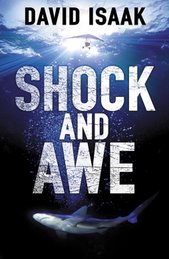
Le Cover...


Arrived home to find this in my e-mailbox. I have to downgrade the resolution to post it here (the lights from above look much nicer ar higher res), but we have a title, we have a cover, soon we will even have page proofs.

Are you suitably shocked? Awed? (Or maybe at least Anded?)