Okay, so you're writing from one POV in a novel. And it's pretty close third-person POV throughout.
First person is more sympathetic. First person doesn't require reminders and tags when you modulate from narrative voice to internal reflection. And first person eliminates a whole slew of pronoun problems.
So remind me again: at page 100, why am I writing my current WIP in close third? I'm sure there's a reason...
Tuesday, June 29, 2010


Friday, June 25, 2010
Plot versus Story versus Godzilla
One of Aliya's posts on plot and literary fiction had me responding at enough length on her Comment Trail that I realized I ought to bring what I had to say over here, rather than inflicting it on unwary visitors to her blog. In other words, I plan to inflict it on you--but I'm assuming that by this point in our relationship, anyone arriving here is a wary visitor.
At the risk of getting off into abstractions, I'd like to distinguish between "story" and "plot."
I do tend to require that novel-length fiction has a story of some sort. For me, "story" boils down to either characters experiencing conflict (within some setting or parameters), or characters on some sort of journey. (Helps if the journey involves some conflict rather than just being a travelogue. But the entirely episodic, picaresque novel has a long and honorable history, and sometimes we're just along for the sightseeing. Hey, if it works, it works.)
Even some of the most purely "literary" fiction that manages to engage me has some sort of conflict. In much of Beckett, it's a matter of someone in conflict with himself, or in conflict with meaninglessness, but you can still say, "This is a story about..."
"Plot," for me, is another matter entirely--it's the mechanics of how the story unfolds. And the mechanics can be big and loud and obvious, or so extremely subtle and apparently minor that people might assert the story is "plotless." (In a successful stream-of-consciousness novel, the 'plot' is disguised as free association; but the mechanics are still put there by the author, who decides what thought will stir up what new association. Thinking about horses and then segueing into a childhood carousel ride flashback is just as plotted as having a man walk in with a gun.)
If you can still say, "This is a story about a man who can't muster up the motivation to get out of bed," then you have a story. Probably not much of an evident plot. Whether the writer can make such a story interesting to the reader is another matter, and I think has a good deal to do with whether the writer is actually engrossed in the story (including the character) to begin with.
I believe that plotless stories tend to become boring when the writer doesn't care about the story or the conflict, and is only writing to watch his or her own cleverness at laying down verbiage. When a good writer cares, it drags the reader right along. But in the worst forms of lit fic, the writer really doesn't give a damn about the story.
I will concede that Joyce probably didn't care all that much about the plot, such as it is, of Ulysses. But he cared powerfully about the characters and what they experienced during the course of that long journey through a day. (Finnegans Wake, on the other hand, doesn't seem to me to have a story anyone cares about; it really is a lot of self-referential cleverness. Some of which is incredibly clever and fun to read aloud, mind you, but it no longer feels like a story. I'm not even sure I consider it a novel: more like an alien artifact.)
It is quite possible to write genre fiction that commits the same sin of not caring about the story. In genre fiction, this usually happens when the writer cares primarily about the plot, but not about the characters except insofar as they serve the plot--which is another way of not really caring about the story.
There's all kinds of ways of breaking the rule that you have to care about the story, or have a story. Borges did it routinely; so did Donald Barthelme. And I adore much of their short fiction. But expand any of those didactic or satiric short pieces to novel length, and you'll find me dropping the book on the floor somewhere around page 20.
On the genre side, the same thing holds for puzzle mysteries--such as the 'locked-room' mysteries which were so popular in the early years of the 20th century: I can enjoy them (well, actually I don't, but I can imagine that someone might) for ten pages or so, but there isn't enough story for a book; it's all plot.
I guess what I'm saying is that I dislike reading hundreds of pages of fiction unless the author gives a damn about something other than his own precious self.
Of course, giving a damn isn't sufficient; there's a lot of heartfelt fiction out there that is just plain awful because of lousy execution. But I'd argue that caring about the story you're telling is a necessary prerequisite to any kind of success in reaching a reader.
Probably the reason that so many lit-fic writers fail in this regard is that they sat through too many classes where professors said things like, "What Shakespeare is teaching us here..." or "What Tolstoy is trying to tell us..." (Many teachers seem to have truly great works of literature confused with Aesop's Fables or Rudyard Kipling's Just-So stories.) Then these students move on to other classes where someone's prose experiments are praised, simply because they are experimental.
No wonder so many MFA students write such lousy novels.
And where does Godzilla fit into all this? Well, what Godzilla was trying to show us was...
Sunday, June 20, 2010
Writing and Peripheral Vision
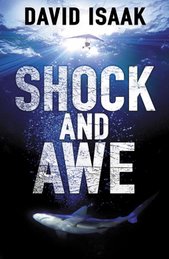
I've made no secret of the fact that 2009 ranks as one of my least favorite years. My health issues so contaminated the novel I was writing that I had to set it aside entirely; even now, it exudes a miasma that seems unhealthy. Since publication of Shock and Awe at the end of 2007, I've completed one novel (Earthly Vessels, which, alas, is entirely unsuited to my MNW autorial persona), and had two others grind to a halt 100-200 pages on in glorious 2009.
I'm not ready to return to those WIPs, though I think both of them are potentially good novels. So I've been working on something new, based on a single opening chapter I wrote some time back. And, to my amazement, it's going swimmingly, and I'm eight chapters along. (Well, as swimmingly as writing has ever gone for me, which is to say 'flounderingly.') I've found I can even write and maintain something akin to normal blood pressure as long as I eventually get up from my desk and go do something reasonably fierce in the way of exercise to blow the tension out of my system.
Since I'm not much of a plot-ahead kind of guy, there are always what-happens-next roadblocks, both large and small. Once I've written a couple of chapters and the characters are alive and contributing their suggestions, I have a good sense of the general direction I'm heading, but the details remain fuzzy. With apologies to Aliya Whiteley's brother and sister characters in Mean Mode Median (and to Tim Stretton for citing a fantasy character with an apostrophe in his name), the best analogy I can come up with is that used by Paul Muad'Dib in Dune when discussing seeing the future: You can get a glimpse of a few hilltops and ridges in the distance, but you have no idea what awaits in the valleys between them.
And, of course, most of one's time is spent traversing the valleys, and sometimes they aren't the valley you're expecting: Instead of the Valley of the Jolly Green Giant, you find yourself in the good old Valley of the Shadow of Death. But there are constant what-happens-next-and-how questions, large and small.
Which brings me, in my typical blabbermouthed fashion, to the point of this post. Very seldom can I solve a story problem by focusing on it. It isn't math(s). Staring longer doesn't allow me to break it down into logical steps.
I should add that it isn't that I'm incapable of coming up with something to happen at the next major undecided point. It's that I can come up with several things, each of which, on careful interrogation, turns out to be unsuitable in some way.
(First ideas for solving intermediate plot points are almost always stale, derivative, or obvious. Well, I speak only for myself, there. Perhaps your first ideas are always strikingly original. I sometimes have strikingly original ideas, and when I get them early and easily, it's almost always a sign that they are striking, and original, and unworkable.)
A certain amount of staring is needed to get the problem fixed in my mind. This can often be achieved by pinpointing exactly why your proposed solutions so far suck. But after that, I have to count on peripheral vision--the answer that is handed to you when you are apparently paying attention to something else.
When I'm lucky, what I'm paying attention to is the writing; the answer to a given plot issue will often pop up--sometimes because some minor element I've written in along the way turns out to be more than merely descriptive, or will fulfill dual roles.
When I'm less lucky, I have to resort to some kind of activity to occupy a part of my brain. The physicist Niels Bohr was famous for solving conceptual problems by fixing the issue in his mind and then forgetting about it by going to see American Westerns--just diverting enough to keep his frontal lobes distracted, but not so complex or emotionally involving as to take over too much of his subconscious mind. (So who says that movies that are all fluff aren't useful?) And I know one oft-published novelist who says that any movie at all will work for him.
Not so for me. Sometimes home-construction tasks will turn the trick, but these can also become so demanding that they take up too much of my all-too-limited brainpower. Gardening works well sometimes, but not always, and that old standby, the shower, sometimes produces results--but one can only spend so long in the shower.
For me, physical motion seems most effective. Walking often allows solutions to pop up; hiking is good, too, except that there is usually a long period where the scenery pushes everything far down, and there is the added problem that when you've solved your problem you are anywhere from ten to a hundred miles away from your keyboard.
Joyce Carol Oates claims to get her best work done while she is running, but Ms Oates is built like one of the more slender species of antelope, and running for her is probably like walking for me. If I could muster up the focus to work on a story issue while running, I would no doubt resolve most of my plot issues by having all my characters sit down and gasp for breath.
Long drives can help, and I find that drives in heavy, high-speed, freeway traffic work best--for some reason, knowing that it's life-endangering to make so much as a note seems to encourage the subconscious to become especially fecund.
The protagonist in my WIP solves urgent problems by thinking hard about something else. This has given me the challenge of coming up with complete non sequiturs for him to contemplate, and "now think of something completely unrelated" isn't as easy as it sounds.
Luckily, my protag doesn't need to get up and move around for this to work. I hope to learn something from writing him.
But meanwhile I need to go exercise. My protag has raised my blood pressure enough for one day.
Sunday, June 13, 2010
Prince of Persia--a flap over nothing
I haven't seen Prince of Persia, nor am I in any great haste to do so. But I have noticed, as many probably have, the huge flap on the web over the fact that "a white actor" is playing a Persian.
Sigh.
Persia, of course, is largely that area now called "Iran." ("Persians" incidentally, always called the place "Iran." The Greeks are the ones who called them Persians.)
Hands up, anybody who knows where the name "Iran" comes from? Anybody? Yes, Ashley?
That's right. "Eran" which in Latin was "Arianus," which in English, is "Aryan." Yep. Hitler's master race. The white people. The Aryans were the root race of what we call Persia.
Now, things changed a bit when Alexander tromped through and his troops inseminated many of the Aryan women there. Though, being Greek and following Alexander, they may have inseminated more of the Aryan men.
And, of course, the Mongol hordes passed through, and killed about a zillion of the Aryan men, and, of course raped many of the women.
And, fairly recently as such things go, the Arabs stormed into the place, killed about a zillion of the men, raped the women, or, worse, married them, and converted everyone to Islam at swordpoint. So now there is a lot of Arab blood running in modern Iranian veins...along with an occasional touch of East Asian that can be seen in the eyelids (the same effect you sometimes see cropping up in Eastern Europe and Germany), as well as some Greek genes, which is why--no, wait, I already did the obvious Greek joke.
I've met many Iranians, and, yes, some of them look a good deal like Arabs. But I've met many who look like total honkies, because--well, if you buy any of the Aryan race crap, they are the spring and lifeblood of honkydom. Which the Germans long recognized, and why Germany and Iran/Persia/Whatever, have long been so cozy.
The Jews and Arabs are the Semitic peoples--or, as Hitler and his gang called them, "mud people." The Persians are the Master Race (and some of them actually believe it).
So, the outrage over casting Jake Gyllenhaal as a mo-fo honkie haole fishbelly ghost person Aryan strikes me as pretty weird. (Plus, the guy isn't as white as, say, Paul Bettany. I've seen lightbulbs that looked dark compared to him.)
Look, I understand that for decades white actors were cast as other races, pushing aside some excellent actors in the process, and that's reprehensible.
On the other hand, I've always enjoyed it in modern film and theater when someone is cast in a different gender--Cate Blanchett as Bob Dylan, for example--or a black man is cast in what is a white role without any comment whatsoever, such as Denzel Washington playing Don Pedro in Branagh's production of "Much Ado About Nothing." So I've always hoped that in the future, no one would much give a shit.
I understand the urge to redress wrongs. But I think the lines often get drawn in the wrong places, and I think this is a great example. I think Jake Gyllenhaal can play an Aryan without any issues whatsoever being raised.
The funny thing is, if they had cast an Arab or a Turk in that role, I don't think we'd be hearing any noise whatsoever--even though racially that's just as extreme as casting Marlon Brando as an Okinawan. (Bad idea, that one--but it was done.)
Then again, I think about it and realize that most Americans think Iranians are Arabs. Hell, the other day I heard someone bitching about all the Middle Easterners moving into his neighborhood, and, after asking a couple of questions, realized he was talking about people from India. So I guess a lot of people are all riled up because they think Jake Gyllenhaal is going to be playing an Arab. Or an Indian. Or, well, one of those kind of people, and a Persian should be played by, like, you know, an Arab or Indian or Mexican or somebody, well, ethnic.
Here's the real problem. The US is filled with people like Miss Teen South Carolina.
I'm much more bothered when Hollywood rewrites stories so that the races of the original characters are changed to white (whatever the fuck that is). There's the problem.
Jake Gyllenhaal playing an Aryan? No problem. Though if I were king, I'd have gone with Jude Law.
=========================
PS There was also a lot of outrage when Jonathan Pryce--a great actor, IMHO--was cast as a Eurasian in Miss Saigon. I couldn't really get that wound up about it. People are pissed that a European was playing a Eurasian--because they thought it needed to be an Asian? Umm, big disconnect for me. "Eurasian" is typically what Hawaiians call "hapa"--50:50.
I can't wait to see what happens when they do a Tiger Woods biopic. Because my guess is that Asian actors won't even be auditioned--even though plenty of Cambodians, Indonesians, and Malaysians look more like Tiger Woods than most black Americans do.
I think they'll probably cast Will Smith.
Sunday, June 6, 2010
That special time of the year...
Christmas in June? No (although the excellent but generally forgotten band The Young Adults had a great song called Christmas in Japan in July). And not summer vacation, either, although I guess it's that time of the year.
No, it's the annual Rancho Mirage Writing Workshop, in the blasting heat of the California desert. A baker's dozen of writers working together and critiquing, under the sharp-tongued guidance of Raymond Obstfeld.
This had become an annual event for me...except for last year, when my health problems kept me from attending. Not so this year. I'm annoyingly hale and hearty, and have my nose and consciousness buried deeply in my latest novel.
We've all received 20-35 pages of each other's manuscripts, and we'll start off with a round-robin critique at 5 this evening. There's some good stuff here, and some very odd stuff, and some familiar stuff that is farther along (pages 540-560 of one manuscript that I last saw many pages back). Some of the writers are veterans of this little workshop, others are fresh meat. This loooks like fun.
So I'm looking forward to a week of nothing but writing and critiquing. Well, along with a few drinks in the evening. And heaving myself into swimming pools to try to dump some of the heat.
"But it's a dry heat," the apologists all say. Yeah, well it's still 110 frigging Farenheit. And with all the golf courses in the area (this is right next to Palm Springs), it ain't really that dry anymore, either.
But it's a dry heat. Yeah, Satan probably says that about Hell, too.
Monday, May 24, 2010
Philip Space, Kelly Day, Ben Dover, et al.
I've just been musing on character names. I put a good deal of time into selecting names for my characters--perhaps more than I ought--and I'm not sure sometimes where to draw the line.
It's clear to me that, as in everything else, we have less latitude in fiction than the degrees of freedom granted to reality. I don't know that there is a Philip Space or a Ben Dover out there in the real world, but there are certainly Kelly Days (most of them probably unaware they are bearing a punning name). Joke names in a novel strike me as a little too sophomoric, but it's amazing how far some writers have pushed that envelope in comic novels. Although the characters Benny Profane and Herbert Stencil in Pynchon's V. aren't exactly punning constructions, they go far beyond the limits of credulity; but, then, Pynchon clearly didn't want us to be involved in his story in any traditional sense.
Here again, reality has us at a disadvantage. If I had an actor as a character in a novel, even a comic novel, I wouldn't name him something like "Rip Torn." But Mr. Torn (whom I admire) is only the latest in a family of Torns where the older males were nicknamed "Rip." In life, it's a conversation starter. In a book, it would be a bit silly and distracting (cf. Benny Profane).
To take another example, until recently the CEO of the Boeing Company was a man named* "Harry Stonecipher." Could we get away with that? No way--not unless we were writing a sequel to V..
But there are milder forms. I have a good friend named "Steve Steele." That's a fine name, but iffy in a novel (and, in my opinion, only serviceable if the character is not any kind of action hero). "Steele" in its possible spellings is a common surname (although famous Hollywood producer Dawn Steel inherited the surname from a father who changed it from Spielberg). But use it in a book and it seems as if the writer is trying to make some not-too-subtle point.
I used to know a fellow named "Bob Dollar." That's a fine, solid surname deriving from the Celtic. (It means, roughly, "from the dales," and has no connection with currency.) Nothing wrong with "Dollar" in real life. But it would be poison in anything but a comic novel, and maybe a little sketchy even there.
There are some names that, for me, land right on the line. "Billy Pilgrim," for example, in Vonnegut's Slaughterhouse-Five, is a feasible and undistracting name for a protagonist--except that it is a little too, as they say in screenwriting, "on the nose." (It also seems to be begging the critics and scholars to dissect it.)
I would never intentionally give a character the initials "J.C.", though writers from William Faulkner to Stephen King have done exactly this, quite purposefully and thematically.
Even though readers will suspend disbelief, at some level they remember the writer is up above the stage, pulling the strings. Names carrying too much obvious baggage or portent seem to aim the spotlight away from the stage and up at the writer. (Which a writer like Pynchon probably desires.)
I can enjoy preposterous and unlikely names as long as they aren't overly burdened with meaning. To take one of Vonnegut's recurring characters, how can one not like "Kilgore Trout"? Dickens was especially delightful and prolific in this regard, although some of his wonderful surnames are so marvelous as to be distracting. (Honeythunder? Pumblechook?)
Many writers can't resist saddling minor characters with real but unusual surnames. I've encountered the English surname "Gotobed" at least a hundred times in novels without ever bumping up against it in the real world. This is never laden with meaning; the writers have simply been amused by the name, and decided they needed to use it someday, somehow, for something. (It always knocks me out of the story by making me think of the Monty Python skit featuring a fellow named Smoketoomuch.)
Of course, what is unremarkable for one reader may be startling for another. An Iranian friend of mine told me that when he first moved to England for college he cold hardly resist laughing every time he met someone who was named for a color: Mr. Green, Mrs. Black, Mr. Brown, Miss Grey...
I'm rambling, here (and, yes, I'm stuck for a surname in my novel at the moment).
I prefer names to be somewhat evocative, but more enigmatic than emblematic. One of my favorites is Orwell's "Winston Smith," a pedestrian surname preceded by a Christian name with aspirations. It's a name you can spend some time considering, but also a name you can skate right across without a second glance. If you want to read something into it, you can, but it doesn't demand anything from the reader.
Ultimately, though, I pick names because I like the way they sound--and because, in my mind, they fit the character. By that I don't mean that they fit the character profile, or the character's thematic role. I mean that in in my mind's eye, if I call the character by that name, they answer.
========================
* n.b. English versus Americanlish:
An interesting divergence of usage has emerge in how our two countries use the word "called" with respect names. In the UK, "named" and "called" are apparently used interchangeably. In the UK, it seems that "In the village lived a man called Smith..." means nothing more than that there was a fellow whose name was Smith.
In Americanlish, "called" is generally used to identify a label for a person which is not the person's given name--that is, the person is named one thing, but called another: "The man named Smith was called Little Smith to distinguish him from the three other Smith families in town in the town..."
BRIT: "In the village lived a man called Smith..."
YANK: "Why did they call him that?"
BRIT: "Well, because it was his name, I suppose."
And a unassailably good reason for calling him that, too. But to the American ear, it seems as if an element of the story is being left out...
Tuesday, May 11, 2010
Babies and Stories: The Dirty Harry Effect
A rather long article in the New York Times Magazine discusses recent research on the moral sense, if you can call it that, of infants. The psychology of babies is a fascinating but relatively new field. (Q: Do I get points for not calling it an "infant" field? A: No, not if I go ahead and say it anyway in this parenthetical.)
I don't plan to summarize the whole of the article. Instead, I want to concentrate on how babies' innate moral senses affect our sense of satisfaction with stories. (As to how babies preferences are determined in this research, you'll have to follow the link and read it there.)
The basic setup is this: Babies are shown a character attempting to do something. Two additional characters are then introduced: one who assists the character ("the helper"), and one who does things that frustrate the character in achieving its goal ("the hinderer").
First result: Babies tend to like the The Helper and to be repelled by The Hinderer. Simple enough. Surprising to those who think babies have no real consciousness, perhaps, but not to the rest of us.
To complicate matters, now introduce two other characters: The Rewarder and The Punisher. (These two characters either provide or take away treats from other characters).
Second results: Babies prefer The Rewarder to the Punisher. Again, not surprising. The Rewarder is being nice. The Punisher is being a bit unpleasant. The Rewarder is like The Helper, and the The Punisher is like the Hinderer.
But now it gets more subtle. First, let The Rewarder and The Punisher interact with The Helper. One might easily predict the outcome. The baby likes The Helper, and is also biased to like The Rewarder and dislike The Punisher, so naturally the baby approves of The Rewarder's actions, and is repelled by the unfair Punisher. Stands to reason: who's gonna like somebody who is mean to the nice one?
But the results are much more interesting when The Rewarder and The Punisher interact with The Hinderer. In this case, babies prefer The Punisher to The Rewarder. Even though they don't like The Punisher much as a character, they want to see The Hinderer punished (and, presumably, are driven a bit daffy if they see The Hinderer being rewarded).
I think of this as "The Dirty Harry Effect," from the iconic Clint Eastwood movies. Harry Callahan isn't anybody you might like, much less anybody a baby might like. He's brutal, breaks the law whenever his sense of justice demands it, and is about as far from being The Rewarder as one might imagine.
When the movie Dirty Harry first hit movie screens in the US, pundits attributed its popularity to many factors: The growing insecurity of white males, the sense of chaos in our urban centers, the frustration with the ineffective and uneven adminstration of criminal justice. Some even warned that the movie would spawn a wave of vigilantism in the country. (I think it had much the opposite effect; as with pornographic movies of the day, I suspect the viewers, erm, got it out of their systems in the theater.)
This new research shows that the appeal of the Dirty Harry setup runs deep. Even babies want to see the bad ones being punished--even though they are instinctively repelled by The Punisher. This appears to be innate in the human personality rather than something that is taught.
In some ways, this research is inspiring, suggesting a deep sense of justice and fairness in human nature. Before we break out the champagne and start toasting ourselves, however, other baby research reveals some rather disturbing further information. All things held equal, babies prefer others who are similar to themselves. As the article reports:
There’s plenty of research showing that babies have within-group preferences: 3-month-olds prefer the faces of the race that is most familiar to them to those of other races; 11-month-olds prefer individuals who share their own taste in food and expect these individuals to be nicer than those with different tastes; 12-month-olds prefer to learn from someone who speaks their own language over someone who speaks a foreign language. And studies with young children have found that once they are segregated into different groups — even under the most arbitrary of schemes, like wearing different colored T-shirts — they eagerly favor their own groups in their attitudes and their actions.
At an abstract level, we like justice; at a more concrete level, our reaction is to side with our tribe in the most simplistic ways, and justice be damned. Hello, Lord of the Flies.
Subscribe to:
Posts (Atom)